Showing posts with label blogosphere. Show all posts

Wednesday, April 13, 2011

Hit Me With Your Best Shot: Beauty's In The Eyes

This post is a contribution to the Hit Me With Your Best Shot series at The Film Experience.

Before I sat down and watched Beauty and the Beast for this entry, I managed to stumble, completely by accident, on an essay that discussed how the film might function as an allegory for the AIDS crisis and how it plays with ideas of gay male types. These ideas had never occurred to me, but they make complete sense - note particularly how the screenwriters have changed the attack on the Beast to be motivated by the general threat to the townspeople and the children he might snatch, whereas the original story is a much more enclosed, personal battle between the lead characters.

But, watching the film again, this wasn't the only suggestion that Beauty and the Beast subverts the traditional, conservative ideals that are generally attributed to Disney's empire. It's very easy to dismiss the film's ending as throwing its laudable moral - love is more than skin-deep - out the window as the Beast transforms back into a handsome white prince, but this ignores not only the groundwork the film has continually laid out, but the very expressive work we can see in the scene of the transformation itself.


On Belle's forbidden visit to the West Wing, the film establishes the key trope of eyes. In contrast to Gaston, who is constantly being distracted by his own reflection, you sense Belle has never really looked in a mirror. Here, she does, and in the cracked glass, she's confronted with about a dozen of her eyes looking back at her. While Gaston, and indeed the rest of the town, conceive of Belle as the 'Beauty' of the title, this shot, early in her time at the castle, sidelines that idea. As the Beast learns to love, Belle learns to see the value in the reality of the world around her. Here, she seems shocked to realise that she even exists, and the multiplicity of eyes reminds her of the value of looking.


It also makes for an intriguing visual correlation with this shot, just moments later. The Beast has ripped apart his portrait, reflecting the mangling of his own beauty by destroying its painted image, but crucially, the eyes remain in-tact. Belle goes to lift the hanging scrap, but she doesn't complete it, suggesting that complete physical beauty is always an afterthought for her.

My pick for best shot.
Which we see in these scenes, essentially of the Beast's 'death'. I'm not sure what it says about my state of mind that my favourite shots from Beauty and the Beast were of characters dying or crying, but it's rather apt and helpful that I really found the beauty in the beast in this shot. I don't think it's accidental - it's designed as a picturesque portraiture, Belle caressing the side of his face delicately. Moreover, it centres the eyes as the bright focal point - so much expression through drawing, a wistful love in the blue. As a frame, it's as carefully designed as the following one of Belle, looking down at him:


If anything, Belle, the supposed 'Beauty' who Gaston basically wanted to frame and preserve rather than love, has less of a portrait than the Beast, though the caressing hand is a poignant visual match to the previous shot. By having Belle looking straight at the 'camera', it positions this shot as a point-of-view shot, as opposed to the portrait of the previous image. But above all, once again, it's the eyes that are the key to the image - bigger pools on Belle's face than the slits on the Beast's, they seem to shine with concern. It's the character design of the entire faces that does the work for both characters, of course, but the images draw focus to the eyes, connecting the couple in what they think are their last moments together.

Finally, crucially, after the Beast has transformed back into the Prince, Belle doesn't care about the handsome new figure in front of her - she finds the answer, that he's still the same being, in his eyes.


Bonus: the geometrical matching of eyes to bodies in this shot of Cogsworth and Lumiere always tickles me.

Wednesday, April 06, 2011

Hit Me With Your Best Shot: Cinematic Creatures

This post is a contribution to the Hit Me With Your Best Shot series at The Film Experience.

"I don't care what you do. Paul and I are going to Hollywood. They're desperately keen to sign us up. We're going to be film stars."

The girls of Heavenly Creatures lose themselves in fantasies of murder, of emigration, and of magical castles, but, particularly because this series focuses on cinematography, it's the cinematic inflection to it all that really sparked my interest.

"Absolutely not! Ugh, Orson Welles! The most hideous man alive!"

Juliet (Kate Winslet) and Pauline's (Melanie Lynskey) deification of various male filmstars is fascinating on various levels, not least in how it plays with the film's navigation of the girls' sexual desires and fantasies. What particularly struck me about this moment, though, was the position of power within their friendship - Pauline is constantly looking with worshipping eyes at Juliet, evidently deifying her friend more than any of the stars in the photos. When Pauline finally suggests her own heterosexual desire, Juliet - seemingly unaware, and certainly uninterested, in Pauline's feelings towards her at this point - isn't just disapproving, she's horrified.


Orson is easily thrown away and quickly consumed by the waterfall. Crucially, the ease and cruelty of this action by Juliet suggests to Pauline that people who are not approved of, or who disrupt their lives, can be simply, cleanly disposed of.

Naturally, it turns out Orson isn't that easy to get rid of.

"I never have never in my life seen anything in the same category of hideousness... 
but I adore him!"

Actor Jean Guérin, as Orson Welles, is inserted into scenes from The Third Man, alongside Joseph Cotten and Trevor Howard, so that when he haunts the girls on their trip home from the theatre, the connection is easy to make. In a perverse way, folding into the domination of the girls' fantasy worlds, Welles acts as a foreshadowing of Pauline's mother - showing the girls how killing someone does not mean you can so easily escape them.

Picking up where he fell off the waterfall, Orson continues interjecting into the power Juliet holds over Pauline. Pauline's voiceover, taken directly from her real diaries, demonstrates her heterosexual desire peeking through the repression she has undertaken at Juliet's distaste, and further, assuming the cinematic realisation of fantasies are attributed to Pauline, this subordination to Juliet bleeds over here. Exhausted, delirious from the fright and thrill that Orson's chase gave them, Pauline kisses Juliet - but then she changes into Orson, and creates my favourite image of the film.


So many of the film's themes seem to come together in this one peculiar image. Juliet's immersion in worlds of imagination. The increasingly present blue chill of the image, making Juliet seem the more unreal of the pair. Sexuality as distorted by cinema's presentation of movie stars. The erotic element of death. The scene, like the film, treads a careful line between hilarity and morbidity, encapsulating both the pleasures and dangers of losing yourself inside invented worlds.

Two runner-up shots, presented without comment:


Wednesday, March 30, 2011

Hit Me With Your Best Shot: Psychotic Breaks

This post is a contribution to the Hit Me With Your Best Shot series at The Film Experience. This post, inevitably, spoils the whole film.

Psycho is so commonly, and easily, reduced to the "shower scene", with perhaps a mention that she wouldn't hurt a fly. It's hard to forget, for anyone, that it's actually one of the almighty Alfred Hitchcock's most masterful pieces, so finely constructed that I still won't accept the final rambling 'explanation' as a mistake so much as something I still don't understand the function of. Legend dulls the shock of the shower scene, but it still has a tensing effect, a supremely nervy quality, that will surely last forever. But the film as a whole, too, is decidedly not one of sustained menace, but continues to play with genre after its sudden switch from following a woman on the run to a horror film. Sam (John Gavin) and Lila (Vera Miles) hanging around waiting for Arboghast (Martin Balsam) appears remarkably film noir.

What I loved this time around about Psycho - this must be at least my fifth viewing, and one of my earliest cinema memories is naughtily stumbling upon the spectre of the looming Bates' house on late-night TV - were the little flourishes of unexpected emotions that are slipped into otherwise tense, straightforward scenes.


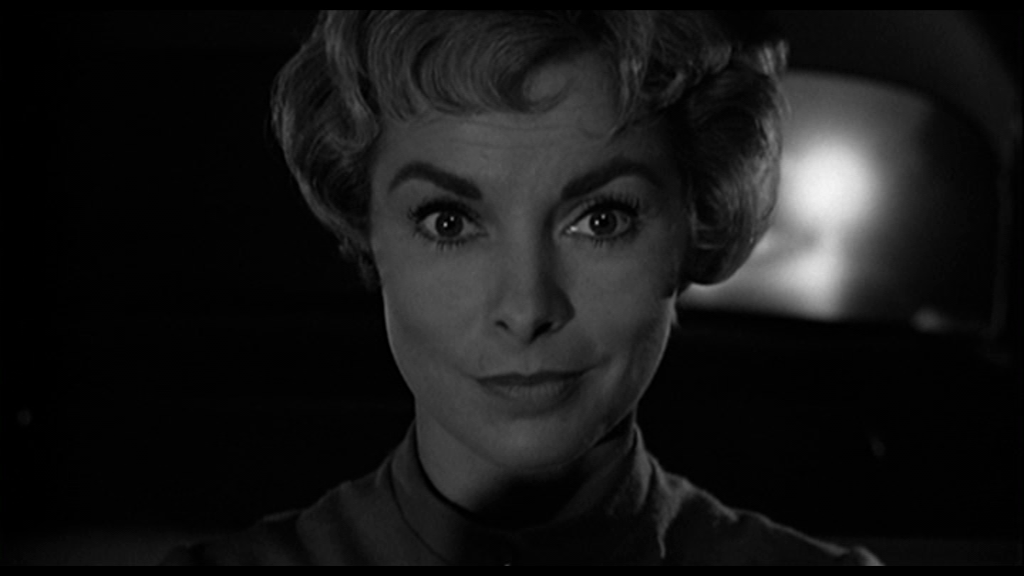
Marion Crane (Janet Leigh) is generally skittish and tense during her impromptu flight with $40,000, and in this scene, as she drives along the highway in the darkness, imagined voice-overs of the people she's running from - police, her employer, her sister - play on the soundtrack. Hitchcock hands the reigns to Leigh, the camera still on her face. Her lips purse, her brow furrows - and then, unexpectedly, her lips curl up into a perverse, proud little smile. Leigh finally gives a possible hint for why Marion's seemingly uncharacteristic move to steal the money might have happened - maybe she just is a little bad.


Another weird little smile, a similar concoction of perversity and pride. Arboghast has been digging into Norman (Anthony Perkins), taking his story apart, and, though it nearly undoes him right there and then, something in Norman - or in his 'mother' - can't resist a wicked little joke.
"Let's put it this way - she might have fooled me... but she didn't fool my mother."
Well I laughed, Norman. I laughed.


Let's go a little gay for a moment. Another little flash of unusual emotion that's more amusing than anything else:
Sometimes, when she talks to me like that, I feel I'd like to go up there... and curse her, and... and leave her forever!
The queer coding in Norman is, of course, blindingly obvious, but this little moment seems more pronounced in how it isn't feminine but queer. Notably, it's Norman separating himself from his 'mother', whether that means her when she was actually alive or merely the part of his brain that operates as 'mother' - this is a Norman identifying as a separate person, not a transvestite but a gay male. Maybe a lot to read into one small moment, but the nuances in Perkins' performance are so complex it more than allows it.

My favourite shot, though, is emotionally extreme for a slightly different reason.


Arboghast examines the guest book and Norman leans over from the end of the counter to look closer, the desperation and panic that's setting in reflected in the extreme angles the camera ends up seeing him from. The camera tracks the movement of Perkins' head but doesn't tilt from its horizontal axis - an ingenious interplay between actor and director to emphasize the escalating emotion of the scene. And the shadows created by the lighting look so gorgeous in black-and-white - the last film Hitchcock made in black-and-white, and probably his final masterpiece.

Wednesday, March 23, 2011

Hit Me With Your Best Shot: Desolate Desire

This post is a contribution to the Hit Me With Your Best Shot series at The Film Experience.

It feels a bit treacherous to Tennessee Williams in his centennial week, or even to the great Elia Kazan (this is surely his finest hour), but I browse the catalogue of screenshots I gathered while watching A Streetcar Named Desire and they're all about the actors - their expressions, their interactions, or merely their physicality. And I don't mean Marlon Brando with half his shirt ripped off, although I don't think anyone would disagree with that.

But what really makes Streetcar spark is the conflict between Blanche and Stanley that's embedded in the acting styles of Brando and Vivien Leigh, and how that complicates, deepens and enriches the relationship Williams created between the two. Stanley is the brute, the primitive man - but Brando's method acting is the new, modern way of performing. Leigh's heightened, classical style make sense of Blanche's wild, unbalanced existence. Streetcar is, finally, a film about two characters who cannot co-exist, and how two disparate acting styles shouldn't either - yet what the combination produces is inflammatory and magnetic while it lasts.

How to choose, though? How to choose between the animalistic intimidation of Stanley, the sensual intoxication of Stella (Kim Hunter), the sudden harsh fierceness of Leigh's face, the gothic spectacle of a limp Blanche, female heads bowed in some sort of fearful prayer, or this perfect encapsulation of the three central characters? My ultimate choice is one disconnected from the film itself - as I write this, somewhat stream of consciousness, I couldn't tell you what happens before or after this shot; I choose it purely for how it looks.


There's something so simple and bare here that kept pulling me back to this shot, over some of the more detailed compositions I mentioned above. Generally, Kazan's framing inside the apartment is quite tight - if a gap in the frame opens up, it's either filled by someone else, or the camera zooms to keep the image packed and claustrophobic. So the space here - the open window, the grey sheet - is unusual. Indeed, as Stanley's words echo eerily through Blanche's head - "Said you were married once, weren't ya?" - the camera zooms quite quickly onto Leigh's face.

But it does linger at this distance first, with a cowed Blanche feeling her first intimidation by the cool, unimpressed Stanley. The shadows (a constant contributor to fascinating shots throughout) creep slightly over her face, and the gossamer fabric makes her both vulnerable, by its slightness, and enveloped by its layers and its darkness. In this frame, Blanche is not trapped or intimidated by the world, the apartment or even Stanley - she's overwhelmed by her very self, closing her finery in on herself so she's suffocated by the very thing she holds highest. The space around her is empty, available, but she doesn't understand how to exist within it. It's the first vibrant indication we get of Blanche's troubled inner self, and it's a desolate one.

Saturday, April 18, 2009

Oh Where, Oh Where Has My Little Dog Gone?

I'm guessing that most people who read this blog are also avid followers of The Film Experience, but just in case you aren't, I've somehow got myself the gig of guest-blogging over there while Nathaniel is off in lovely Nashville. So I'll be posting various interesting/not interesting things over there for the next week or so.

But there'll be stuff here in a few days too, have no fear. With The Class earlier today, and my decision that Blindness can be chucked overboard (it's not my fault they didn't send it to me), my 2008 roster is complete enough (Synecdoche, New York doesn't appear for yet more months, and god only knows if I'll ever actually watch Che) that I can stick my Gold Stars on those most impressive achievers from last year and finally get this blog into the new year. It's only April after all.

Sunday, February 22, 2009

Gee-Ni-Us


It's Oscar night tonight, but important things surrounding them are already afoot. Yes, I'm talking about the annual Supporting Actress Oscar Smackdown at StinkyLulu, which he was gracious enough to allow me to participate in, along with himself and seven other fantastic bloggers. Click over here to read our takes on each of the five nominees, and discover who came out on top. (You might want to take a little detour on your way there, though: Nathaniel at The Film Experience has been imagining this fight going down for real and he's shared it with his readers.) Supporting Actress is apparently one of the first announced at the ceremony tonight, so you won't have to wait long to find out who AMPAS themselves give the prize to.

Sunday, January 04, 2009

Supporting Actress Blog-a-thon, Class of 2008: Emmanuelle Devos in A Christmas Tale

I always have a problem with deciding whom to write on for StinkyLulu's most prominent of blog-a-thons, the Supporting Actress Blog-A-Thon, mainly because most of the "big" (read: Oscar) movies have yet to arrive on these shores and contenders are usually plucked from them. So who to choose? After seeing The Reader yesterday I briefly considered Lena Olin, but I decided I just didn't love that performance enough; and the National Society of Film Critics' pick of Hanna Schygulla in The Edge of Heaven reminded me of just how great she, and indeed the film, were. (And let's not forget Hallam Foe's Claire Forlani, who I almost wrote about last year too...) But there's always been one actress in the forefront of my mind for this honour.

I first came across Emmanuelle Devos in Arnaud Desplechin's superb Kings and Queen a few years ago, and it's with Desplechin she reunited this year for the role I have chosen to highlight...

Faunia in A Christmas Tale (Un conte de Noël)

Faunia is not actually a member of the family who reunite for Noël; she is the lover of eldest son Henri (Mathieu Almaric), who is somewhat of a black sheep and has actually been banished from his sister Elizabeth's (Anne Consigny) life. Faunia is somewhat reluctant to accompany Henri- whom she hasn't exactly been with for very long- to his family Christmas (particularly since she's Jewish), but accompany she does, and her somewhat looser attitude to life helps skew the family just that extra bit.

The entire cast of A Christmas Tale is terrific- it's a true ensemble piece- but Devos, intentionally, stands apart from the pack. The part seems to rely in part on Devos' natural charisma- the screen seems to get jolted, just a little, everytime she appears on screen. Faunia isn't, outwardly, bothered by the company forced upon her- you imagine she is acting how she would act anywhere else, not caring what the family think of her. Nevertheless, all this could make Faunia a cold, unattractive character, but Devos takes the material she is given and shades it beautifully. Observing the family, Devos gives just a hint of wistfulness- the idea that somewhere inside her is a wish for more closeness that she grants herself. The interaction with Henri, once they reach the family home, is surprisingly limited, lending evidence to the idea that this is not a relationship based on anything much at all. She treats his wilful impulses with an impassive role of the eyes. Faunia leaves on Christmas Eve, leaving Henri with just a kiss on the cheek.

Devos' most prominent scene- and, indeed, the one that got her this post- comes when Faunia goes shopping and walks around an art gallery with the family's matriarch, Junon (Catherine Deneuve). [IndieWire helpfully provides a tidbit of this scene.] The pair discuss Junon's family- and toss off things like "I always wondered what he [Henri- her son!] was like in bed"- with almost disinterested flippancy as they try on dresses and examine paintings. But it's in the art gallery where Devos shines- you see, all at once, her outsider status, her unrivalled comprehension of the complicated family, and her hidden wistfulness for something more. Faunia never says that Henri and she have no future, but Devos knows she knows it, knows that although she may want closeness, this is not the family she'll develop it with. As an outsider- the only true one, since the other siblings are married with children- Faunia is the only one who can reflect objectively on how the family functions, in traditionally dysfunctive fashion. Devos plays the part with subtlety, but also demonstrates a thrilling charisma- which, when up against French legend Deneuve, is quite a feat, and makes one wonder why she's isn't more beloved than she is.

Tuesday, December 30, 2008

The Endings Blog-A-Thon: The Truman Show

This post is part of the cute little J.D.'s blog-a-thon, The Endings. Head over there to read other fantastic posts from across the blogosphere! [There are, obviously, spoilers from here on.]


Truman Burbank (Jim Carrey), unknowingly the star of a massive, continuous television show, is finally making his escape, and, having weathered the rainstorm created by the controllers above, emerges into the light on his battered boat, and the head of it suddenly crashes through what still appears to be distant sky.

This ending obviously plays up the God allegory that is apparent throughout the movie: director Peter Weir emphasizes Christof's (Ed Harris) omnipotent presence by cutting halfway through a couple of his lines here to show how they echo, facelessly over the entirity of Truman's world, accompanied by a shot of the glistening clouds in the perfectly blue sky. So, this ending, ultimately, is about the throwing off blind faith, as Truman, having questioned his acceptance of this world throughout the film, finally decides to use his rebellious thoughts and act. As he says himself, "You never had a camera inside my head!" Weir's not afraid to be ironic, here, though: as she watches Truman on the edge of freedom, his former love interest (and 'Free Truman!' leader) Sylvia (Natascha McElhone) is basically praying to her television, and even says "Please God!" (left) as she wills Truman to step out the door. Perhaps Christof is right when he says that "there's no more truth out there"- there is still blind, unconscious belief in someone who can manipulate our lives.

The film is also, naturally, about television itself. Throughout the film we visit various international viewers of The Truman Show, who are all on tenterhooks as Truman makes his escape, and all celebrate as he leaves. But do the workers at the Truman Bar not realise that this is their livelihood walking out of the door? Do the two old women clutching a Truman cushion not realise that this might be their last connection to any kind of outside world? At least the carpark workers get it right: "Where's the TV guide?" Television, too, is clearly telegraphed as a kind of religion: people sit blindly before it, believing that what they see is true human existance. What Truman realises is that it is not. How will he survive, is an unanswered question, when all he knows is a world that has been shaped to facilitate soap-opera dynamics?

All this is managed to perfection, as Weir creates an ending that asks questions rather than answers them, gives a traditional happy ending while also leaving worrying doubts hanging around. Do I well-up as the music swells over Truman's tearful, angry banging against the wall (right)? Of course. Do I cheer as he makes his bow- "And in case I don't see ya..."- and McElhone ecstatically runs to meet him? Yes. But do I also wonder what happens once Truman leaves the building, and whether he and Sylvia live happily ever after? YES. (But it's also something I never want to know, so don't go making belated sequels.) This is a film that I have always loved, always admired, always championed. And this contradictory, thrilling, poignant ending is just a part of why.

Saturday, August 02, 2008

My Own Cinema For The Week

Since I intentionally yet inadvertantly (work that one out) hurt J.D.'s feelings, I thought I'd make it up to him by actually doing the meme he tagged me for (whether this is good enough as an apology, only he can judge...). By the by, each night's subtitles are inspired by the continually hilarious use of the word "fracking" in Battlestar Galactica (which is very very good, although I suppose that shouldn't surprise me), which, while a canny way of escaping television censorship, wouldn't get around my mother.

1) Choose 12 Films to be featured. They could be random selections or part of a greater theme. Whatever you want.

2) Explain why you chose the films.

3) Link back to Lazy Eye Theatre so I can have hundreds of links and I can take those links and spread them all out on the bed and then roll around in them.

4) The people selected then have to turn around and select 5 more people.


Night #1: Flicking FunThe More the Merrier (George Stevens, 1943)
Tie Me Up! Tie Me Down! (Pedro Almodovar, 1990)

I went through a whole raft of Classic Hollywood 'screwball' comedies (possibly my favourite genre) before settling on the little-seen The More the Merrier... Jean Arthur and Joel McCrea are two of the wittiest and charismatic stars, and it's disheartening to see how they're so overlooked. The film is about house-sharing during the Second World War... naturally, such close proximity of strangers makes for hilariously awkward consequences. But romantic, too, and cleverly constructed... it's a gem. And then, for the second film of the night, I've picked Almodovar's screwball-inspired Tie Me Up! Tie Me Down! (or simply Atame! in its original form), which is sick, twisted, and an overlooked (see a theme here?) stroke of genius. Victoria Abril is on cracking form, as a porn star kidnapped (and tied up) by ex-lover Antonio Banderas. You'll never forget it, I swear. And just imagine what the sex scenes look like on a big screen...

Night #2: Flick DownToy Story (Jon Lasseter, 1995)
Babe (Chris Noonan, 1995)

A night from my childhood- both are from 1995, when I turned 7, and both are absolute staples of my young film viewing. Toy Story is still Pixar's best (these Wall-E people are crazy), and I still remember the story about my younger sister (who would have been almost 4) sleeping through the entire thing. Babe, though, feels like it's always been there- I had the video, the toy, even the hot water-bottle cover, I read the Dick King Smith book it was based on. Whenever I watch it, it warms my heart. And hopefully, this double bill will do the same for its imaginary audience.

Night #3: Brit FlickThe Way to the Stars (Anthony Asquith, 1945)
A Fish Called Wanda (Charles Crichton, 1988)

Being a rare British voice in this circle of the blogosphere, I feel it my duty to have at least one night that offers up the best this country has to offer. The Way to the Stars is easily one of the best films produced both during and about the Second World War- genuine, funny, realistic, and beautifully performed by a stellar cast (particularly Rosamund Johns). And then, for some light relief, its John Cleese's classic A Fish Called Wanda (from 1988, the year of my birth), which is one of the funniest films ever made anywhere.

Night #4: Flick LoveBachelor Mother (Garson Kanin, 1939)
Paris, Texas (Wim Wenders, 1984)

When I go in for love (figuratively speaking), I don't really go for the traditional, straightforward romantic comedy (not that there's anything wrong with that, and I enjoy a great deal of them. But anyway.). No, I go for tragedy, perversity, oddball and single mothers (well, not really with the last one). And this is exemplified by this double bill. Bachelor Mother is terrific vehicle for the comedienne in Ginger Rogers, who here plays a store clerk who is mistakenly believed to be the mother of a foundling by boss' son David Niven (incidentally, boss is Charles Coburn, popping up again after being seen earlier this week in The More the Merrier). Hijinks and a predictable end ensue, but it's a fantastic watch. And Paris, Texas is Wim Wenders' masterpiece (sorry, Wings of Desire), the painful story of a man rediscovering his identity and the family he left behind. No happy endings here, just beautiful filmmaking.

Night #5: Inspect-a-FlicksLa double vie de Veronique (Krzysztof Kieslowski, 1991)
Vivre sa vie (Jean-Luc Godard, 1962)

It's pure chance that both of my more 'existential' picks are both foreign- and, indeed, both French. Krzysztof Kieslowski may be best known for his towering Three Colours trilogy but it's this precursor in his catalogue that I love most deeply- Irene Jacob is bewitching as both Veronique and Weronika, two women whose lives prove inscrutable mirrors of each other. And in Vivre sa vie, one of Jean-Luc Godard's earliest pictures, his wife Anna Karina is just as fascinating as Nana, whose life is told in twelve unconventional chapters. I think this penultimate night is a time to engage your brain fully before it revolts at the final night...

Night #6: Flick OffSpeed (Jan De Bont, 1994)
Bug
(William Friedkin, 2006)

I get my movie thrills in different ways, and this final pairing shows just how differently I try and achieve this. Speed is pure adrenaline, one of the first 'adult' movies I remember seeing- I recently bought the DVD because my VHS had finally given out from me watching it so much. It is, perhaps, the only film I can take Keanu Reeves in, and is also to be credited/blamed with starting my love affair with Sandra Bullock (she's not giving me enough to work with anyone, dammit!). And for our final film, we have one of the finest films of recent times, the pyschological and physical freakout that is Bug. DVD isn't enough for this masterclass from William Friedkin- I need the massive cinema screen late at night that was my first viewing. Both films pack a walloping punch- I'll be shaking, whether it be from excitement or pure unadulterated fear.

I know I'm supposed to tag people, but I'm not exactly the most sociable of bloggers and I think most people I know will already have been tagged. But feel free to take the baton if no one else has passed it to you.

Sunday, May 11, 2008

The Nearest (Well, Almost) Book

J.D. tagged me, and who am I to say no when he says I'm one of his best friends? Flattery will get you everywhere.

1. Pick up the nearest book.
2. Open to page 123.
3. Locate the fifth sentence.
4. Post the next three sentences on your blog and in so doing...
5. Tag five people, and acknowledge who tagged me.


Well, sir, I am currently (and unfortunately, but we won't go into that) at university and thus have in various parts of this desk-thingmagig (that doesn't have enough room for a chair in its anorexic centre) all the books I had to read from this year's modules. Sadly, that's all, because I don't have the time to read anything I actually want to read, and they're waiting elsewhere for me to ignore this summer when my brain won't be able to take in another printed word without a warning siren going off. Not that all these books are bad, and, in the spirit of Italo Calvino, I'm going to pass over the Books-I-Haven't-Finished (*ignores 'Orlando'*) and the Books-I-Could-Give-A-Crap-About (*throws aside 'The Scarlet Letter'*) and the Books-I-Just-Plain-Hated (*rips apart Walt Whitman*) and pick up one that I absolutely loved. It's the magnum opus of George Eliot, Middlemarch.

But results which depend on human conscience and intelligence work slowly, and now at the end of 1829, most medical practice was still strutting or shambling along the old paths, and there was still scientific work to be done which might have seemed to be a direct sequence of Bichart's. This great seer did not go beyond the consideration of the tissues as ultimate facts in the living organism, marking the limit of anatomical analysis; but it was open to another mind to say, have not these structures some common basis from which they have all started, as your sarsnet, gauze, net, satin and velvet from the raw cocoon? Here would be another light, as of oxy-hydrogen, showing the very grain of things, and revising all former explanations.

I can almost see you readers nodding off. That's hardly representative of why this book's great. This particular passage- not very far through this 688 page book at all- concerns one of the novel's two main characters, the doctor Tertius Lydgate, and some kind of medical ponderation.

How about something more filmic? This is from what my lecturers sold as one of the essential books we'd need; and fittingly enough, I haven't used it once. This is Film Art, by David Bordwell and Kristen Thompson:

Many critics suggest that the 1970s subgenre of family horror films, such as The Exorcist and Poltergeist, reflect social concerns about the breakup of American families. Others suggest that the genre's questioning of normality and traditional categories is in tune with both the post-Vietnam and post-Cold War eras: Viewers may be uncertain of their fundamental beliefs about the world and their place in it. The continuing popularity of the teenage-orientated slasher series during the 1980s and 1990s might cater to young people's fascination with and simultaneous anxieties about sexuality and violence- enhanced by sophisticated special-effects capable of creating gory and grotesque scenes.

How thrilling.

And I tag YOU. Why aren't you doing it yet? Go!

Friday, March 07, 2008

My Dinner With... Jeanne Moreau

I've been tagged by Nathaniel over @ The Film Experience... I'd just like to thank him for providing me with such a panic-inducer of a meme. Everyone knows I'm no good at social interaction! Dinner equals disaster. I just know I'll trip and send those dishes flying...

1. Pick a single person past or present who works in the film industry who you'd like to have dinner with and tell us why you chose this person.
I've decided to make a date with Jeanne Moreau.

I wavered and pondered over who I could invite to this shindig. But I couldn't think of anyone who I could really hold an evening long conversation with... I'd either be too prone to slap them for their recent misbehaviour (that means you, Jodie... and you too, Uma!), or too entranced by them to say much except "uh-huh". And the idea of bringing back someone from the dead is too unnerving for words. But Jeanne, sex symbol she may have been, always had an aura of generousness to her, and a sense that her feet were the firmest on the ground in any given place. She's a legend, yes, but an approachable one, and an endlessly fascinating one. Hopefully, we'd get on like a house on fire.

This is also a way of capping my almost-complete university module on the French New Wave, during which we watched not only what is probably Jeanne's most famous film, Jules et Jim, but also her breakthrough, Louis Malle's L'Ascenseur pour l'echafaud.

2. Set the table for your dinner. What would you eat? Would it be in a home or at a restaurant? And what would you wear? Feel free to elaborate on the details.
I'm no chef, so we're definitely off to a restaurant. Jeanne has recently turned eighty so she can wear whatever she feels comfortable in... however, she deserves the best, so I'm wearing a spotless dinner jacket. I'll take the Eurostar over to Paris (where I assume she lives, or at least nearby) and we'll go to a quiet but classy restaurant, where Jeanne can order whatever she likes. I'll pay any bill for this legend.

3. List five thoughtful questions you would ask this person during dinner.
1. You are perhaps the only French actress who was a large, influencial force in the New Wave and was recognised independantly of- and in some cases was more famous than- the directors. Do you see yourself as an important creative force in the movement, or simply someone under the guidance of those who around you?

2. You headed the Cannes jury in 1995. What was the experience like? Did you feel comfortable in control, or was the experience more a communal one?

3. You recently starred in Francois Ozon's Time to Leave, playing Melvin Poupaud's grandmother. Is working with and encouraging young actors important to you? Do you see that you have anything useful to teach the next generation of performers?

4. With such international fame and sex-symbol status there must surely have been the opportunity to leave entirely for Hollywood. Did you ever consider it? And do you think you've maintained a satisfactory balance between projects over the years?

5. You've not stopped working even into your ninth decade. Do you think you'll ever stop, and does working in cinema still hold the same value for you?

4. When all is said and done, select six bloggers to pass this Meme along to. Link back to Lazy Eye Theatre, so that people know the mastermind behind this Meme.
I'm tagging J.D., Glenn, Cal, Jesse, Scott, and Catherine. Who may choose to ignore this as if they never even read it. (Ooh, burn...)