[Starter for Ten (Tom Vaughan, 2006/7): I read a critique of Starter for Ten almost immediatly having watched it which advised "Great for Americans; avoid if you're a Brit though" and continued to savage the film for not being the next Trainspotting or A Clockwork Orange. This interesting perspective has one good idea and one bad: perhaps Dudley Nicholls' story paints England as a bit too picturesque, a bit too unchallenging- nothing serious ever invades the lives of these supposedly realistic characters, but then, nothing was ever meant to. To go onto the bad idea of this argument: Starter for Ten was never intending to be a serious look at British life, it was simply content to be a slightly Americanized, predictable cross between a coming-of-age story and a romantic triangle. And on these bases, it's hard to deny that Starter for Ten is successful. James McAvoy, that young Scottish star who seems to have appeared from nowhere to take the world by storm, is effortlessly charming as Brian Jackson, a young man who braves Bristol University in 1985, young in experience but eager to learn. An afectionado of British tv quiz University Challenge, he immediatly seizes the opportunity to get on the team, and there meets the beautiful Alice (Alice Eve), a girl who he immediatly falls for and who may or may not feel the same. Into the frame, however, comes Rebecca (Rebecca Hall), a headtrong political student who sagely comments on Brian's life whenever she sees him, but who is not above being charmed by his unconventional approach. Starter for Ten unfolds in a straight, easy-to-follow trajection; it's so predictable that Vaughan might as well have had characters holding up arrows to point the way. But the three leads are almost unexpectedly charming: Alice Eve and Rebecca Hall provide obvious counterpoints to each other, but both have their own expressive qualities that should serve them well in the future. When the film comes to its obvious conclusion, its hard to keep a smile from brimming on your face, because, predictable or no, the best conclusion has come. Grade: B-]
[Borat: Cultural Learnings of America for Make Benefit Glorious Nation of Kazakhstan (Larry Charles, 2006): The hyperbole surrounding the critical and audience sensation of 2006 became so great that my desire to see it faded to nothing between the weeks of its release and my eventual trip to see it. Said trip was taken with my younger sister, who had already seen (and liked) it, but was happy to sit through it again so she could see Pan's Labyrinth with me afterwards. Said trip was also for the 11:00am showing, which meant, unsurprisingly, that the cinema was rather bare: a few people dotted around and two teenage groups huddled at the back row. Unstandably the laughter that these people could possibly illicit wasn't exactly going to be racuous, but I got even less than I expected, and it was not hard to see why. Forget what you've heard: Borat isn't funny. Oh, I won't deny that occasionally I chuckled, but surely this is damning next to praise like "so funny it'll burst half the blood vessels in your face" (Empire). Worse still are all the claims that Borat is an incisive cultural commentary: it's not. It's just a selectively edited trip around America, occasionally encountering bigoted people who are surprisingly fluid with their opinions, but the film doesn't use this to actually say anything. So there are bigoted people in America- there are bigoted people everywhere! And in the sections in which Borat isn't encountering these people, he's embarassing perfectly acceptable human beings in the name of comedy which is rarely even funny. For Borat's main claim is that it's a comedy- the problem being, it's not funny. Grade: C]

Thursday, November 30, 2006

Tuesday, November 21, 2006
The Piano (1993)
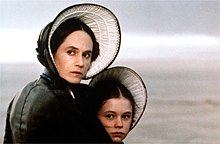 The Piano (Jane Campion, 1993)
Jane Campion's The Piano is one of those rare, wonderful films that not only stands up to repeated viewings, but it gets better every time, never losing its power but somehow building on it. The infamous 'finger' scene is, on first viewing, perhaps simply sickening, but on a third I found it deeply unsettling, and a rapidly-following fourth viewing led me to actually weep while I watched it. Campion takes the traditional genre of a melodrama, or perhaps more specifically a 'woman's picture', and bends it, almost pulling a veil over your eyes, so that it's never really recognisable as such. Her dextrous visual style makes the film flow with an unsettling lucidity, both fitting in and standing incongruously with the narrative. Campion has said that she wanted the film to seem as if it were taking place underwater- hence the moody blue-green photography, but the sense of drowning is a constant one, as Holly Hunter's Ada McGrath tries to surface from the barren, dull landscape of the muddy New Zealand hills and her marriage to the simply-minded Sam Neill, whose failing to understand Ada's relationship to both her piano and her daughter (Anna Paquin) proves to be his undoing. If the stereotyping of the Aboriginals perhaps seems a bit racist, look again: yes, Campion's script does paint them as naive, inexperienced foreigners, but then this is a film from the perspective of the colonizers, not the colonized- to Ada, and indeed Neill's Stewart, the Aboriginals are strange and perhaps stupid, but at least they fit blissfully into the nature around them, something Ada struggles valiantly to do and that Stewart is so jealous of, perhaps, or more fittingly unable to comprehend, that he cuts it down and builds barriers within it. I, for one, know I love a film when I can pick out specific moments of performance or visual style that I love: here, I love the way the square-on camera loses its breath along with Ada when Stewart jumps out from behind a tree; I love Paquin's fiery delivery of the line "To hell!"; I love Paquin's galling sobs after the 'finger' scene; I love Hunter's smile to herself when Baines (Harvey Keitel) walks out of the village hall;... . The performances of The Piano are so deeply seated within it, so different in style yet so perfectly fit together; the style is creepily moody yet beautifully flowing; the music is rythmic yet unsettled; everything about it might seem initially unwielding, but Campion weaves a beautiful tapestry out of all these different elements, creating a film that is at once deeply haunting and deeply satisfying. It leave you with the idea that in the days, like Ada, you will feel happy and contented with it; but at night, when only the darkness surrounds you, you will be haunted by the unease of the film, the complexities of its emotion, and the contradictions seeping through its every pore. Grade: A
Tuesday, November 07, 2006
Random Harvest
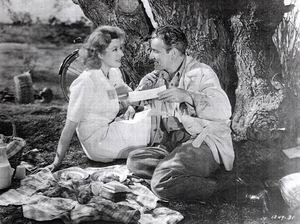 Random Harvest (dir. Mervyn Le Roy, 1942)
A representative staple of old Hollywood tearjerkers, Random Harvest has maintained a surprisingly strong reputation since it's release over sixty years ago, probably because of its notably barmy plot, which involves amnesia, amnesia, and a bit more amnesia. Amnesia, of course, is a very handy plot device, because it can instantly make a character forget- and indeed remember- at the drop of a hat; all you need to do is knock them over, and ta-da! In Random Harvest, however, amnesia is not simply a plot device, it IS the plot, almost body and soul. We open in a British asylum, where an unnamed WWI veteran is spending the last few days of the war, retained inside solely because he has nowhere to be sent, having lost any memory of his former life in 1917 while at the battlefields. On the day the war finishes, the man (Ronald Colman) somehow manages to slip out unnoticed into the rejoicing town below, where a friendly stranger named Paula (Greer Garson) saves him from being returned to the asylum, and kindly takes the bewildered man back to where she's performing that night. Rapidly becoming aware of the danger her new friend is in, Paula takes him away to the country, where, to no surprise, they fall in love and get married.
I'll ignore the blaring question of how it's possible to get married when you don't know your own name and simply say that to enjoy Random Harvest, it's necessary to take it with a large pinch of salt. As tearjerkers go, it is for the most part remarkably restrained, thanks in no small part to Greer Garson, who, when the film does an abrupt u-turn and knocks Colman's memory into reverse- he suddenly remembers that he's Charles Rainier, an aristocrat, but forgets all about Paula and his infant son- is asked to shoulder the large majority of the film's emotional wallop, and she does so with her usual committed underplaying. A remarkable scene places Charles side-on near the camera, with Paula stationed just behind; here, Charles is unknowingly discussing his past with his wife, who of course he doesn't know his wife, and he is in fact happily engaged to Kitty (Oscar nominated Susan Peters). Garson flickers desperation across her face, desperately but silently searching for any sign in Charles' face that he remembers, sadly recognising that it's a lost cause but looking all the same. Garson, who was overlooked by Oscar (she won for William Wyler's Mrs. Miniver the same year, so it can hardly be quarrelled with), is one of the great forgotten actresses: I've yet to see her less than radiant; even when given an obvious role (Blossoms of the Dust), she makes it something special. Here she gives possibly her best peformance, deeply devoted and desperately sad, the emotional core of the film as Colman is forced to be the unknowing ostensible centre.
As I said, amnesia is an easy plot device to work with, which perhaps makes it quite a surprise that the film so delays its resolution; indeed, despite Garson's committed work, the film can't help but begin to drag somewhat- after all, it should be obvious to everyone from the start that everything will work out in the end, and it becomes quite a chore waiting for the obvious to occur. The film is also rather weak at properly portraying passages of time: over ten years is skipped at one point, yet no-one seems to have aged a day and it takes a while for anyone to inform us of this leap in time. This is another chance for me to highlight the excellence of Garson; she's dextrously able to imply years of silent suffering with just a few glances. Colman, by contrast, isn't as able; whenever asked to actually portray the sadness of a lost memory or unexplainable doubt in his actions, he never really succeeds, at one key point simply staring off into the distance. Peters is solid enough if not particuarly notable in a role than never gives her much to work with; and the only other person of note is Henry Travers, and simply because your probably response will be "It's Clarence!" (as, indeed, my mother's was).
By the time is reaches its suprisingly brief emotional reunion, Random Harvest has put you through the wringer in two very different ways: while Garson is busy gently but wrenchingly sliding you through the rollers, the editor has his feet up and his hand firmly on the crank. As a representation of its genre, the film is recommended, but make sure your seat is comfy and your mouth not ready to yawn. Random Harvest is completely hokey, but it knows it, and the gusto that all involved have thrown into is to be admired, even if it ultimately proves difficult to straight-forwardly enjoy. Grade: B-
I'll ignore the blaring question of how it's possible to get married when you don't know your own name and simply say that to enjoy Random Harvest, it's necessary to take it with a large pinch of salt. As tearjerkers go, it is for the most part remarkably restrained, thanks in no small part to Greer Garson, who, when the film does an abrupt u-turn and knocks Colman's memory into reverse- he suddenly remembers that he's Charles Rainier, an aristocrat, but forgets all about Paula and his infant son- is asked to shoulder the large majority of the film's emotional wallop, and she does so with her usual committed underplaying. A remarkable scene places Charles side-on near the camera, with Paula stationed just behind; here, Charles is unknowingly discussing his past with his wife, who of course he doesn't know his wife, and he is in fact happily engaged to Kitty (Oscar nominated Susan Peters). Garson flickers desperation across her face, desperately but silently searching for any sign in Charles' face that he remembers, sadly recognising that it's a lost cause but looking all the same. Garson, who was overlooked by Oscar (she won for William Wyler's Mrs. Miniver the same year, so it can hardly be quarrelled with), is one of the great forgotten actresses: I've yet to see her less than radiant; even when given an obvious role (Blossoms of the Dust), she makes it something special. Here she gives possibly her best peformance, deeply devoted and desperately sad, the emotional core of the film as Colman is forced to be the unknowing ostensible centre.
As I said, amnesia is an easy plot device to work with, which perhaps makes it quite a surprise that the film so delays its resolution; indeed, despite Garson's committed work, the film can't help but begin to drag somewhat- after all, it should be obvious to everyone from the start that everything will work out in the end, and it becomes quite a chore waiting for the obvious to occur. The film is also rather weak at properly portraying passages of time: over ten years is skipped at one point, yet no-one seems to have aged a day and it takes a while for anyone to inform us of this leap in time. This is another chance for me to highlight the excellence of Garson; she's dextrously able to imply years of silent suffering with just a few glances. Colman, by contrast, isn't as able; whenever asked to actually portray the sadness of a lost memory or unexplainable doubt in his actions, he never really succeeds, at one key point simply staring off into the distance. Peters is solid enough if not particuarly notable in a role than never gives her much to work with; and the only other person of note is Henry Travers, and simply because your probably response will be "It's Clarence!" (as, indeed, my mother's was).
By the time is reaches its suprisingly brief emotional reunion, Random Harvest has put you through the wringer in two very different ways: while Garson is busy gently but wrenchingly sliding you through the rollers, the editor has his feet up and his hand firmly on the crank. As a representation of its genre, the film is recommended, but make sure your seat is comfy and your mouth not ready to yawn. Random Harvest is completely hokey, but it knows it, and the gusto that all involved have thrown into is to be admired, even if it ultimately proves difficult to straight-forwardly enjoy. Grade: B-
Little Children, Scenes of a Sexual Nature and Slither
[Little Children (Todd Field, 2006): The initially middling grade I gave Little Children probably sprung for my intense desire to want to like it, to admire it, to say that the acting here covers up the horrendous mess of the script and direction. Kate Winslet is undoubtably my favourite modern actress, and maybe it just wounds me too much to say that even she can't make up for the deficencies here. There's nothing particularly wrong with her performance here; indeed, it's probably as good as it could have been, save perhaps for the scene where, ironically, she shows the most emotion. (The moment feels so odd, fitting in I suppose with the histrionics the script constantly visits; but in the context of repressed surburban housewife, it's jarring.) There's little, indeed, wrong with most of the performances here: Patrick Wilson, Jackie Earle Haley, Phyllis Somerville, Jane Adams, and particularly Jennifer Connelly (able, as always, to mine so much out of an underwritten and marginalized role) are all fine, often excellent- only Noah Emmerich is bad, a garish performance which suits the film around him better than do the other actors- but they're all slaving away in service of a confused, puzzling mess of a film which thinks it knows so much when it knows so little. It throws you off right from the beginning, the stale, sage narration of some always-unknown quantity striking up at irregular intervals and never, really, serving a purpose apart from highlighting things the audience should be left to understand on their own. But what's worst about Little Children is it's smugness- Todd Field and Tom Perrotta's script (adapted from Perrotta's well-recieved novel) sits there, laden with a strange bitterness and pessimism that is never explained, winding it's way through a serious of rather unexciting events concerning- and how ironic this is- adults acting like "little children", selfish and irresponsible, all wanting to feel needed and loved, trying to make their lives worthwhile. Even before it reaches it's bizarre and conflicted climax, Little Children navigates various levels of over-egged histrionics and self-involved events, abandoning all sense of balance to the talented cast to try and sort out- it's not their fault, I cry, vainly trying to convince myself that it deserves attention; but really, there are better performances out there that warrant attention, and Kate the Great will have to wait a few more years for that thin golden statuette. Grade: D+]
[Scenes of a Sexual Nature (Ed Blum, 2006/7): Even worse than the smugness of Little Children is the smugness of Scenes of a Sexual Nature, which has even less claim to the idea of knowledge than Todd Field's unweilding mess. No, here is a film which, like Little Children, has employed a talented cast- Ewan McGregor, Polly Walker, Sophie Okonedo, Andrew Lincoln, Eileen Atkins, et al- to act out its complacent "ideas" about sexuality, this time in the form of seven criss-crossing vignettes between various couplings. The first false note is struck by the sickeningly twinkly and whimsical score, which, as one review I read commenting, "will make you want to kill yourself". The script is hollow and empty, full of cliched lines and situations- most of the vignettes seem like the more boring scenes from a common romantic comedy, the bits you'd sit sighing through waiting for the amusing comedic side-kick to re-appear, because they're the real reason you paid the ticket price. The talent of the cast, and the reasonable performances they give, somehow makes the whole thing even worse- how, I ask loudly, could all these actors be conned into starring in this horrific mess? Oh, and I never, ever want to go to Hampstead Heath, thanks. Grade: F]
[Slither (James Gunn, 2006): The delirious joys of Slither take a while to kick in, but when they do, oh-ho-ho, they don't let go. In the spirit of '80's alien horrors, but without their laughable effects (Slither looks, at times, frighteningly realistic), James Gunn's debut is a witty, exciting ride, expertly balancing comedy and horror and never over-dosing on either. The cast is game, with Serenity's Nathan Fillion playing the hero with a reluctant gusto, and Elizabeth Banks is both a funny and sympathetic straight-face as the wife of the man-turned-monster (and, naturally, the object of Fillion's affections). Overall, Slither's narrative goes in a predictable direction, but Gunn has a lot of fun in the intermediate scenes, constantly springing gory surprises that provide for some hilarious lines. To use a familiar expression: no, it's not Citizen Kane, but there's a lot of fun to be had by all. Grade: B]
[Scenes of a Sexual Nature (Ed Blum, 2006/7): Even worse than the smugness of Little Children is the smugness of Scenes of a Sexual Nature, which has even less claim to the idea of knowledge than Todd Field's unweilding mess. No, here is a film which, like Little Children, has employed a talented cast- Ewan McGregor, Polly Walker, Sophie Okonedo, Andrew Lincoln, Eileen Atkins, et al- to act out its complacent "ideas" about sexuality, this time in the form of seven criss-crossing vignettes between various couplings. The first false note is struck by the sickeningly twinkly and whimsical score, which, as one review I read commenting, "will make you want to kill yourself". The script is hollow and empty, full of cliched lines and situations- most of the vignettes seem like the more boring scenes from a common romantic comedy, the bits you'd sit sighing through waiting for the amusing comedic side-kick to re-appear, because they're the real reason you paid the ticket price. The talent of the cast, and the reasonable performances they give, somehow makes the whole thing even worse- how, I ask loudly, could all these actors be conned into starring in this horrific mess? Oh, and I never, ever want to go to Hampstead Heath, thanks. Grade: F]
[Slither (James Gunn, 2006): The delirious joys of Slither take a while to kick in, but when they do, oh-ho-ho, they don't let go. In the spirit of '80's alien horrors, but without their laughable effects (Slither looks, at times, frighteningly realistic), James Gunn's debut is a witty, exciting ride, expertly balancing comedy and horror and never over-dosing on either. The cast is game, with Serenity's Nathan Fillion playing the hero with a reluctant gusto, and Elizabeth Banks is both a funny and sympathetic straight-face as the wife of the man-turned-monster (and, naturally, the object of Fillion's affections). Overall, Slither's narrative goes in a predictable direction, but Gunn has a lot of fun in the intermediate scenes, constantly springing gory surprises that provide for some hilarious lines. To use a familiar expression: no, it's not Citizen Kane, but there's a lot of fun to be had by all. Grade: B]
Thursday, November 02, 2006
Quinceanera, Ask the Dust and Half Nelson
[Quinceanera (Wash Westmoreland & Richard Glatzer, 2006): Quinceanera, or Echo Park L.A. as it was bafflingly re-named for Britain, plays like a lot of tv dramas do: a low-rent cast plays out predictable and pedestrian histrionics, occasionally hitting a true note but mostly succumbing to the familiar and unloved script. I suppose I should give it points for trying to tackle subjects like the gentrification of the Latino area of L.A. and teenage sexuality, but haven't we seen these things before? The pieces of the puzzle never really fit together: Magdalena (Emily Rios) is thrown out just before her quinceanera (fifteenth birthday) because, miraculously, she is a pregnant virgin; meanwhile her cousin Carlos (Jesse Garcia), thrown out of his home because his father discovered he was gay, starts sleeping with his new landlords. And their new guardian, kindly Uncle Tomas (Chalo Gonzalez), gently tries to reconcile his breaking family and their ties to their religion. Magdalena is ostensibly the centre of the piece, which would explain why Carlos' thread is almost left in thin air; and is the depiction of his landlords as a promiscuous couple taking advantage of a hot young cholo exactly a positive message from these two gay filmmakers? The whole thing concludes itself obviously and perfunctorially, at least giving Garcia a short chance to impress, but Quinceanera's surface depiction of its themes ultimately leaves you feeling distant and disappointed. Grade: C]
[Ask the Dust (Robert Towne, 2006): Ask the Dust isn't just an adaptation of a book to screen, it's an adaptation of book about someone who writes books, and I'm not sure it's possible to get less cinematic than that. Luckily (or unluckily) most of it doesn't actually focus on the writing of a novel, more the inspirations that our central character, Arturo Bandini (Colin Farrell), tries to find for his writing. Arturo, by the way, is supposed to be an Italian living in L.A., which makes the casting of Farrell even more perplexing than his complete blankness in the role: an Irish man playing an Italian who sounds entirely American. Salma Hayek is more handily cast as a Mexican waitress named Camilla Lopez, whom the script tries to convince us has a turbulent relationship with Arturo. The early part of this relationship plays out in the restaurant where Camilla works, and where a down-hearted Arturo, down to his last nickel, comes to drown his sorrows in a cup of coffee. The bizarrities of these scenes are so strange that I'd suggest you see for yourself if I weren't of the strong mind that no one should ever see this film, so let us just say that they mostly involve shoes. There then follows an appaulingly lit sequence where both Hayek and Farrell strip off and frolick in the sea, playing out their tempestuous love-hate thing once again, only wet and without clothes. The major problem is that Towne becomes convinced of their intrinsic attraction almost before it's even started, and certainly far before his audience have been convinced, and instead the script just takes it as a given that these two's stars are entwined. So when the film abandons Camilla for a brief while, we are treated to an almost-as-bizarre interlude with Idina Menzel's physically scarred nutcase, who lives next to a fairground and serves absolutely no purpose whatsoever. Donald Sutherland serves even less purpose in his role as Arturo's slightly unbalanced and clearly unwashed neighbour, while Eileen Atkins is wasted in the background as Arturo's landlady. Ask the Dust is never horrifying awful, if just for the fact that it's so lifeless that even to get horrified would make it more worthwhile. Nothing inside it ever comes off, from the script to the set decoration, and the actors wonder around inside a hollow shell without even bumping into its sides, because, well, that'd actually be interesting. Grade: D-]
[Half Nelson (Ryan Fleck, 2006): Half Nelson has gathered attention mostly for the impressive performance of hot young thing Ryan Gosling in its central role; but Gosling is hardly the sort of actor who wants to be a star, and I highly doubt he took this role with that aim in mind. It's easy to see why it has gathered press, though: Gosling's performance is a precisely measured but never obvious one, perfectly portrayed but never portrayed as being portrayed. He's almost matched, though, by young Shakeera Epps, as the student who discovers his secret and finds herself stuck between two avenues of life. Half Nelson's emotional distance is occasionally too much, as Fleck and Anna Boden's script becomes too sparse for its own good, but Gosling and Epps keep everything grounded and compelling. Most impressively, the film is never judgmental, simply presenting the dark dilemmas of the two characters as fact and seeing how they deal with them. Sometimes, a matter-of-fact approach is more effective than a moralising one, and that's certainly the case here; the film is so far from trying to make a point that it its the viewer who makes one for themselves. Grade: B]
[Ask the Dust (Robert Towne, 2006): Ask the Dust isn't just an adaptation of a book to screen, it's an adaptation of book about someone who writes books, and I'm not sure it's possible to get less cinematic than that. Luckily (or unluckily) most of it doesn't actually focus on the writing of a novel, more the inspirations that our central character, Arturo Bandini (Colin Farrell), tries to find for his writing. Arturo, by the way, is supposed to be an Italian living in L.A., which makes the casting of Farrell even more perplexing than his complete blankness in the role: an Irish man playing an Italian who sounds entirely American. Salma Hayek is more handily cast as a Mexican waitress named Camilla Lopez, whom the script tries to convince us has a turbulent relationship with Arturo. The early part of this relationship plays out in the restaurant where Camilla works, and where a down-hearted Arturo, down to his last nickel, comes to drown his sorrows in a cup of coffee. The bizarrities of these scenes are so strange that I'd suggest you see for yourself if I weren't of the strong mind that no one should ever see this film, so let us just say that they mostly involve shoes. There then follows an appaulingly lit sequence where both Hayek and Farrell strip off and frolick in the sea, playing out their tempestuous love-hate thing once again, only wet and without clothes. The major problem is that Towne becomes convinced of their intrinsic attraction almost before it's even started, and certainly far before his audience have been convinced, and instead the script just takes it as a given that these two's stars are entwined. So when the film abandons Camilla for a brief while, we are treated to an almost-as-bizarre interlude with Idina Menzel's physically scarred nutcase, who lives next to a fairground and serves absolutely no purpose whatsoever. Donald Sutherland serves even less purpose in his role as Arturo's slightly unbalanced and clearly unwashed neighbour, while Eileen Atkins is wasted in the background as Arturo's landlady. Ask the Dust is never horrifying awful, if just for the fact that it's so lifeless that even to get horrified would make it more worthwhile. Nothing inside it ever comes off, from the script to the set decoration, and the actors wonder around inside a hollow shell without even bumping into its sides, because, well, that'd actually be interesting. Grade: D-]
[Half Nelson (Ryan Fleck, 2006): Half Nelson has gathered attention mostly for the impressive performance of hot young thing Ryan Gosling in its central role; but Gosling is hardly the sort of actor who wants to be a star, and I highly doubt he took this role with that aim in mind. It's easy to see why it has gathered press, though: Gosling's performance is a precisely measured but never obvious one, perfectly portrayed but never portrayed as being portrayed. He's almost matched, though, by young Shakeera Epps, as the student who discovers his secret and finds herself stuck between two avenues of life. Half Nelson's emotional distance is occasionally too much, as Fleck and Anna Boden's script becomes too sparse for its own good, but Gosling and Epps keep everything grounded and compelling. Most impressively, the film is never judgmental, simply presenting the dark dilemmas of the two characters as fact and seeing how they deal with them. Sometimes, a matter-of-fact approach is more effective than a moralising one, and that's certainly the case here; the film is so far from trying to make a point that it its the viewer who makes one for themselves. Grade: B]
Wednesday, October 25, 2006
The Last Kiss and Tristan + Isolde
[The Last Kiss (Tony Goldwyn, 2006): Less of a vanity project for Scrubs star Zach Braff than his directorial debut Garden State was a couple of years ago, The Last Kiss kind of gives itself away in its title, but I suppose we can blame that on Gabriele Muccino's Italian original L'ultimo bacio (literally The Last Kiss) and not screenwriter Paul Haggis, whose involvement here seems somewhat odd based on his recent Oscar prestige (Crash and Million Dollar Baby, and possibly Flags of Our Fathers this year) but is nevertheless a sign that the film has more on its mind that empty-headed cliches. Though Braff does, indeed, get the most screentime, this remains a nice ensemble piece, with a cast of undeniably talented and surprisingly well-cast mix of old and young around him. Blythe Danner and Tom Wilkinson inhabit the mirroring middle-age saga with a quiet dignity and often movingly underplayed drama. Meanwhile, the underrated Jacinda Barrett (appearing in a slew of starkly different movies this year, including Poseidon and The Namesake) and O.C. starlet Rachel Bilson (in her film debut) are the two women in 29-year-old Braff's life, as he faces up to a family life with Barrett by dalliancing with Bilson. The Last Kiss is absolutely nothing new, but Haggis' script is pleasingly astute, and it's put across with solid and often moving performances; my main problem is perhaps the soundtrack- perfectly fitting, enjoyable songs (including Snow Patrol's Chocolate and Imogen Heap's haunting Hide and Seek) that are nevertheless enormously intrusive whenever they blare up on the sound-system. And if only Goldwyn had had the nerve to end it just ten seconds before he does... Grade: B-]
[Tristan + Isolde (Kevin Reynolds, 2006): Tristan + Isolde clearly wants us to see it as hip, if that trendy plus sign in it's title is anything to go by. Nevermind the fact that Baz Lurhmann's Romeo + Juliet actually warranted this idea, and that was made ten years ago. Nothing about Tristan + Isolde is hip; nothing about it needs to be. A tragic romantic tale apparently pre-dating Romeo and Juliet, the story has little of the impact of that classic tale, and it's native feuding between Ireland and Britain fails to impress on any level. In fact, that is the main problem here: the romantic tale is perfectly fine- often moving, constantly involving and well-played- but the film seems to be struggling with itself, far too intent on this warring battle which is something we've seen done better many times before. Nevermind that they have one excellent performance in Sophia Myles, who puts on a pleasant Irish burr as she tears herself up between her husband King Mark (Rufus Sewell) and his second Tristan (James Franco). Nevermind that Artur Reinhart's photography is gorgeous, a haunting mixture of blue and grey hues, hanging over the film like a warning. And nevermind that the film moves so briskly that it makes Braveheart look like Shoah. If Tristan + Isolde had reigned in it's focus to the tragic romance, it would have, ironically, been so much more. Grade: C+]
[Tristan + Isolde (Kevin Reynolds, 2006): Tristan + Isolde clearly wants us to see it as hip, if that trendy plus sign in it's title is anything to go by. Nevermind the fact that Baz Lurhmann's Romeo + Juliet actually warranted this idea, and that was made ten years ago. Nothing about Tristan + Isolde is hip; nothing about it needs to be. A tragic romantic tale apparently pre-dating Romeo and Juliet, the story has little of the impact of that classic tale, and it's native feuding between Ireland and Britain fails to impress on any level. In fact, that is the main problem here: the romantic tale is perfectly fine- often moving, constantly involving and well-played- but the film seems to be struggling with itself, far too intent on this warring battle which is something we've seen done better many times before. Nevermind that they have one excellent performance in Sophia Myles, who puts on a pleasant Irish burr as she tears herself up between her husband King Mark (Rufus Sewell) and his second Tristan (James Franco). Nevermind that Artur Reinhart's photography is gorgeous, a haunting mixture of blue and grey hues, hanging over the film like a warning. And nevermind that the film moves so briskly that it makes Braveheart look like Shoah. If Tristan + Isolde had reigned in it's focus to the tragic romance, it would have, ironically, been so much more. Grade: C+]
Wednesday, October 18, 2006
Clean; Death of a President; Tie Me Up! Tie Me Down!
[Clean (Olivier Assayas, 2006): Assayas reunites with his ex-wife Maggie Cheung for this slow but engrossing study of a drug-addicted wife of a recently-dead musician, who desperately tries to get her life back on track for the sake of her son, who has been living with her husband's parents since he was born. Clean seems to have provoked intriguingly disparate reactions from the critical community, but suffice to say, this viewer found it strikingly off-kilter, eschewing the usual cliches of drug addiction and recovery and instead taking a more sublte approach. Cheung fits perfectly into this mould, never giving the audience anything obvious to latch onto and instead delicately constructing a painful, interior woman who can't quite let go of what she knows she must. Assayas' direction is genius- my favourite scene probably comes where Cheung meets up with her father-in-law (a rugged, impressive Nick Nolte) in a train station, and runs off suddenly only to sharply change her mind. Amongst the crowd, Assayas' camera tracks but often loses it's subject, but, symbolically, it always gets there eventually. Grade: B+]
[Death of a President (Gabriel Range, 2006): This controversial British-made psuedo-documentary debuted on tv over here, and after a while the advert breaks become less annoying than there are during the first half of the film. Range's take on the assassination of President Bush provides gripping viewing while the event itself is built up to and takes place- a seamless use of stock footage digitally integrated- but it totally loses itself when it tackles the ensuing investigation, eschewing the possibilities of social and political commentary for a streamlined, messy 'who-dunnit' situation, albeit with ethnic minorities. But it's exploration of race is far too surface, too obvious, and it finishes with the depressing feeling that it could have been so, so much more. Grade: C]
[Tie Me Up! Tie Me Down! (Pedro Almodovar, 1990): What seems to me an Almodovarian take on the screwball comedy, with the slightly psychotic Antonio Banderas heading straight for his one-night-stand Victoria Abril, a recovering drug-addict and ex-porn actress, with the intention of making her his wife. To ensure this end, he ties her to the bed and tapes over her mouth while he leaves, effectively kidnapping her in her own home. With usual Almodovar themes of twisted sexuality, madness, and the like, it's hardly a grand departure (when is it ever?), but it certainly struck me as one his most successful films. Drawing on the electric chemistry between it's two stars, the satirical edge of the film is brilliant, challenging Hollywood conventions of traditional romance right up to it's deliriously silly (and simultaneously romantic) ending. If you (like me) are exploring Almodovar's earlier works, this should jump to the top of your list. Grade: A-]
[Death of a President (Gabriel Range, 2006): This controversial British-made psuedo-documentary debuted on tv over here, and after a while the advert breaks become less annoying than there are during the first half of the film. Range's take on the assassination of President Bush provides gripping viewing while the event itself is built up to and takes place- a seamless use of stock footage digitally integrated- but it totally loses itself when it tackles the ensuing investigation, eschewing the possibilities of social and political commentary for a streamlined, messy 'who-dunnit' situation, albeit with ethnic minorities. But it's exploration of race is far too surface, too obvious, and it finishes with the depressing feeling that it could have been so, so much more. Grade: C]
[Tie Me Up! Tie Me Down! (Pedro Almodovar, 1990): What seems to me an Almodovarian take on the screwball comedy, with the slightly psychotic Antonio Banderas heading straight for his one-night-stand Victoria Abril, a recovering drug-addict and ex-porn actress, with the intention of making her his wife. To ensure this end, he ties her to the bed and tapes over her mouth while he leaves, effectively kidnapping her in her own home. With usual Almodovar themes of twisted sexuality, madness, and the like, it's hardly a grand departure (when is it ever?), but it certainly struck me as one his most successful films. Drawing on the electric chemistry between it's two stars, the satirical edge of the film is brilliant, challenging Hollywood conventions of traditional romance right up to it's deliriously silly (and simultaneously romantic) ending. If you (like me) are exploring Almodovar's earlier works, this should jump to the top of your list. Grade: A-]
Friday, October 13, 2006
A Wong Kar-Wai Collection
The first film my new university course fellows and I was treated to, on our first day no less, was Wong Kar-wai's critically-adored, notably beautiful, but also (at least in this viewer's eyes) distressingly slim and uninvolving, In the Mood for Love. Nevertheless, the superb visual stylings and intriguingly deft direction left me with a strange hunger to explore more of his back-catalogue, which, thanks to the university library's dvd collection, I could now do on a whim. So I checked out the three available I had yet to see: As Tears Go By, Days of Being Wild and Happy Together, and sat down and gorged myself, with sizeable breaks in-between, on a Hong Kong movie fest. The result proferred surprisingly unexpected reactions.
True to my anal-retentive fashion, I of course viewed them in chronological order, which offers an intriguing insight into a directorial development that is rarely found nowadays. Most directors, David Cronenberg for instance, hover around the same thematic moods but explore different subjects; but in Kar-wai, we see a director honing selective themes, never really losing ideas from his previous films but working them in a more precise fashion. Chungking Express, the first Kar-wai I ever saw, lives only in my memory for now, but that film's duet of romantic complications does indeed seem to fit in with Kar-wai's development.
[As Tears Go By (Wong Kar-wai, 1988): Kar-wai's first full-length feature (he had been a successful screenwriter beforehand) is a familiar Eastern gangster pic, a traditional balancing act between love and war. Wah (Andy Lau) is continually bailing out his ambitious little brother Fly (Jacky Cheung) but doesn't really have the drive to go far in the business himself. When his cousin Ngor (Maggie Cheung) arrives to stay with him, they form a bond that leads Wah to go in search of her when she returns to her more rural home. The typicality of the film in terms of the gangster genre of Hong Kong at that time is quite surprising, and it seems to me that the film has only gathered favourable attention because it was Kar-wai's debut. It does have a few of his notable qualities- vagueness of plot, soft focus, slow-mo techniques- but it never coheres, striking a bizarre balance between the two plot threads and unfortunately never becoming particularly engrossing. Of the actors, Lau fares best in both role and performance- a young Maggie Cheung seems uncharacteristically lost. Grade: C]
[Days of Being Wild (Wong Kar-wai, 1991): With this film, Kar-wai reportedly wanted to break the excessive popularity of the gangster movie (that he had so conformed to in the film above) with a romantic drama. Days of Being Wild presents a more familiar Kar-wai, though he was yet to fine-tune his narrative vagueness into a coherent whole (perhaps because he was trying to set up an abandoned sequel). Like In the Mood for Love, though not as evocatively or prominently, Days of Being Wild takes place in the 1960s, where sexual predator Leslie Cheung dumps Maggie Cheung, who can't get her mind off him until she meets a policeman (Andy Lau), and moves onto the erratic Rebecca Pan, all the while pestering his adoptive mother to tell him who his true mother is. The more expressive emotional themes Kar-wai employs here lead unsurprisingly to a deeper film, filmed by frequent collaborator, and photographic maverick, Christopher Doyle in a gorgeous soft focus, but Kar-wai was, as mentioned, yet to form totally coherent plots- the film is almost too vague in it's emotional complications, never really sure of itself and jerking off in strange directions. Nevertheless, it's an engrossing watch, well performed and a fair indicator of where Kar-wai was eventually going to reach. Grade: B-]
[Happy Together (Wong Kar-wai, 1997): Happy Together was one of Kar-wai's most critically disliked films, but it happens to be one of his best, happily marrying a thin plot laden with emotion to Kar-wai's striking style. The slow but moving tale of two male lovers in a deeply problematic relationship in Buenos Aires gives Kar-wai plenty of room to employ what he likes best, and perhaps most immediatly striking is the contrast between colour and black and white. Starting the film with a sexually-explicit prelude which is both in Hong Kong and in black and white, Kar-wai employs perhaps the idea of a nostalgic point-of-view, as Lai Yiu-fai (Tony Cheung), the more reserved and unhappy of the pairing, reflects on what his relationship once was. Kar-wai constantly plays with perspective, not just through cinematography but through character- subtle shifts in performance tone perhaps clue us in to the idea that we have switched from one lover to the other, as Ho Po-wing (Leslie Cheung)'s selfish demands are dialled down and the negativity switches instead to Lai Yiu-fai's downcast reticence. This delicate imbalancing is just as due to the actors as to Kar-wai, and both Cheungs (no relation) acquit themselves extremely convincingly, sketching an entangled past without showing it to us and drawing a sad portrait of human dependancy. Grade: B+]
True to my anal-retentive fashion, I of course viewed them in chronological order, which offers an intriguing insight into a directorial development that is rarely found nowadays. Most directors, David Cronenberg for instance, hover around the same thematic moods but explore different subjects; but in Kar-wai, we see a director honing selective themes, never really losing ideas from his previous films but working them in a more precise fashion. Chungking Express, the first Kar-wai I ever saw, lives only in my memory for now, but that film's duet of romantic complications does indeed seem to fit in with Kar-wai's development.
[As Tears Go By (Wong Kar-wai, 1988): Kar-wai's first full-length feature (he had been a successful screenwriter beforehand) is a familiar Eastern gangster pic, a traditional balancing act between love and war. Wah (Andy Lau) is continually bailing out his ambitious little brother Fly (Jacky Cheung) but doesn't really have the drive to go far in the business himself. When his cousin Ngor (Maggie Cheung) arrives to stay with him, they form a bond that leads Wah to go in search of her when she returns to her more rural home. The typicality of the film in terms of the gangster genre of Hong Kong at that time is quite surprising, and it seems to me that the film has only gathered favourable attention because it was Kar-wai's debut. It does have a few of his notable qualities- vagueness of plot, soft focus, slow-mo techniques- but it never coheres, striking a bizarre balance between the two plot threads and unfortunately never becoming particularly engrossing. Of the actors, Lau fares best in both role and performance- a young Maggie Cheung seems uncharacteristically lost. Grade: C]
[Days of Being Wild (Wong Kar-wai, 1991): With this film, Kar-wai reportedly wanted to break the excessive popularity of the gangster movie (that he had so conformed to in the film above) with a romantic drama. Days of Being Wild presents a more familiar Kar-wai, though he was yet to fine-tune his narrative vagueness into a coherent whole (perhaps because he was trying to set up an abandoned sequel). Like In the Mood for Love, though not as evocatively or prominently, Days of Being Wild takes place in the 1960s, where sexual predator Leslie Cheung dumps Maggie Cheung, who can't get her mind off him until she meets a policeman (Andy Lau), and moves onto the erratic Rebecca Pan, all the while pestering his adoptive mother to tell him who his true mother is. The more expressive emotional themes Kar-wai employs here lead unsurprisingly to a deeper film, filmed by frequent collaborator, and photographic maverick, Christopher Doyle in a gorgeous soft focus, but Kar-wai was, as mentioned, yet to form totally coherent plots- the film is almost too vague in it's emotional complications, never really sure of itself and jerking off in strange directions. Nevertheless, it's an engrossing watch, well performed and a fair indicator of where Kar-wai was eventually going to reach. Grade: B-]
[Happy Together (Wong Kar-wai, 1997): Happy Together was one of Kar-wai's most critically disliked films, but it happens to be one of his best, happily marrying a thin plot laden with emotion to Kar-wai's striking style. The slow but moving tale of two male lovers in a deeply problematic relationship in Buenos Aires gives Kar-wai plenty of room to employ what he likes best, and perhaps most immediatly striking is the contrast between colour and black and white. Starting the film with a sexually-explicit prelude which is both in Hong Kong and in black and white, Kar-wai employs perhaps the idea of a nostalgic point-of-view, as Lai Yiu-fai (Tony Cheung), the more reserved and unhappy of the pairing, reflects on what his relationship once was. Kar-wai constantly plays with perspective, not just through cinematography but through character- subtle shifts in performance tone perhaps clue us in to the idea that we have switched from one lover to the other, as Ho Po-wing (Leslie Cheung)'s selfish demands are dialled down and the negativity switches instead to Lai Yiu-fai's downcast reticence. This delicate imbalancing is just as due to the actors as to Kar-wai, and both Cheungs (no relation) acquit themselves extremely convincingly, sketching an entangled past without showing it to us and drawing a sad portrait of human dependancy. Grade: B+]
Wednesday, October 04, 2006
World Trade Center, L'Enfant and The Shawshank Redemption
[World Trade Center (Oliver Stone, 2006): Stone's earnest attempt to portray specific events of the 9/11 terrorist attack stumbles almost before it starts, with the rather pathetic casting of the inexplicable superstar Nicolas Cage, whom I have no shame in saying is one of my most hated actors. Even crushed under rubble for most of the picture, he becomes no more tolerable. However, Stone has managed to gather some positive talent: Crash's Michael Pena, stalwart Maria Bello (with some alarmingly blue contacts) and the rising star Maggie Gyllenhaal round out the central quartet of characters, with some impressive character actors like Michael Shannon (to be seen in a lead role later this year in Bug) and Viola Davis flickering at the edges. Stone eschews the gripping realism of Paul Greengrass's acclaimed United 93 for a more sentimental and Hollywood-ized view of things, with surprisingly populist themes like religion (Jesus appears to Pena in visions) in full view. The main problem is that Stone makes the necessary (Cage and Pena trapped) quite boring, and the unnecessary (their wives anxiously awating news) the more interesting side of things- but it never escapes the feeling that this shouldn't be part of the film. As the two wives (who meet only briefly) are played by Gyllenhaal and Bello, the level of acting is very high, although neither are able to avoid the melodramatic script and direction. As a film it's very well designed- the recreation of the ensuing rubble, under which we spend much of our time, is exceptional, although Stone never really maximises the obvious feelings of claustrophobia we should be feeling. I wouldn't say it does the brave people of the actual event a disservice, it simply doesn't convince us that we're watching them. Grade: C+]
[L'Enfant (Jean-Pierre & Luc Dardenne, 2006): L'Enfant's central conceit is an obvious one, though somehow I felt perversely proud about figuring it out so quickly- the child of the title is ostentatiously the newborn baby of teenage couple Bruno (Jeremie Renier) and Sonia (Deborah Francois), but isn't it really referring to Bruno himself, whom we quickly realise is still a child, but a child in the body and position of an adult. Bruno is a thief who refuses to work, and lives off his dealings with shady characters and Sonia's welfare. The child-like status of both Bruno and Sonia is quickly established: as the film begins and Sonia returns with her newborn baby Jimmy, we witness the immature, playful rapport between the lovers, constantly play-fighting and sparring with each other. It is Bruno's immaturity that ultimately leads to his downfall: clearly not understanding the delicate importance of the baby to Sonia (or indeed to himself), he sells the baby, which makes Sonia collapse and the hospital call the police in. Even in his quest to regain the baby, and then make his way with his young, school-age apprentice (Jeremie Segard) to get some more money, Bruno's naiveity and inexperience is clear. The daring decision to not include any non-diagetic music (indeed, the only music heard is the soothing classical music that is the subject of a playful disagreement between Sonia and Bruno) by the Dardennes, right down to the credits, adds to the pounding, desperate realism of the film, almost completely devoid of humour: we are not here to laugh, we are here to be aghast. And aghast we are indeed. Grade: B]
[The Shawshank Redemption (Frank Darabont, 1994): Exactly what made The Shawshank Redemption such an enormous hit escapes me. A third, unscheduled viewing with my new flatmates at university perhaps weilded some answers: those who had seen it before chuckled and gasped at all the designated moments, while the newly initiated were more emotionally overwhelmed. Indeed, my first viewing (a while ago now) left me reeling, shocked at the developments (admittedly well disguised, in the same kind of way that The Sixth Sense is) and loving it. But a second viewing revealed the cracks: Tim Robbins' Andy Dufresne is an empty vessel of earnestness, the idea that life outside prison is unbearable for those who've been inside for so long seems perverse, and the film is often overwhelming sentimental. Morgan Freeman started his wise narration schtick here, and it was perhaps never more successful, as Red becomes the far more interesting character and you start wishing we could watch his journey instead. The overbearing hamminess of prison warden Samuel Norton (Bob Gunton) is rather painful; yet, despite all these problems, The Shawshank Redemption does actually work, though not as well as some may have you believe. It's 142 minutes are suprisingly speedy, and it makes you smile more than it makes your eyes roll. But don't go in expecting a masterpiece, if you happen to be one of the two people in the world yet to see this inexplicable phenomenon. Grade: B]
[L'Enfant (Jean-Pierre & Luc Dardenne, 2006): L'Enfant's central conceit is an obvious one, though somehow I felt perversely proud about figuring it out so quickly- the child of the title is ostentatiously the newborn baby of teenage couple Bruno (Jeremie Renier) and Sonia (Deborah Francois), but isn't it really referring to Bruno himself, whom we quickly realise is still a child, but a child in the body and position of an adult. Bruno is a thief who refuses to work, and lives off his dealings with shady characters and Sonia's welfare. The child-like status of both Bruno and Sonia is quickly established: as the film begins and Sonia returns with her newborn baby Jimmy, we witness the immature, playful rapport between the lovers, constantly play-fighting and sparring with each other. It is Bruno's immaturity that ultimately leads to his downfall: clearly not understanding the delicate importance of the baby to Sonia (or indeed to himself), he sells the baby, which makes Sonia collapse and the hospital call the police in. Even in his quest to regain the baby, and then make his way with his young, school-age apprentice (Jeremie Segard) to get some more money, Bruno's naiveity and inexperience is clear. The daring decision to not include any non-diagetic music (indeed, the only music heard is the soothing classical music that is the subject of a playful disagreement between Sonia and Bruno) by the Dardennes, right down to the credits, adds to the pounding, desperate realism of the film, almost completely devoid of humour: we are not here to laugh, we are here to be aghast. And aghast we are indeed. Grade: B]
[The Shawshank Redemption (Frank Darabont, 1994): Exactly what made The Shawshank Redemption such an enormous hit escapes me. A third, unscheduled viewing with my new flatmates at university perhaps weilded some answers: those who had seen it before chuckled and gasped at all the designated moments, while the newly initiated were more emotionally overwhelmed. Indeed, my first viewing (a while ago now) left me reeling, shocked at the developments (admittedly well disguised, in the same kind of way that The Sixth Sense is) and loving it. But a second viewing revealed the cracks: Tim Robbins' Andy Dufresne is an empty vessel of earnestness, the idea that life outside prison is unbearable for those who've been inside for so long seems perverse, and the film is often overwhelming sentimental. Morgan Freeman started his wise narration schtick here, and it was perhaps never more successful, as Red becomes the far more interesting character and you start wishing we could watch his journey instead. The overbearing hamminess of prison warden Samuel Norton (Bob Gunton) is rather painful; yet, despite all these problems, The Shawshank Redemption does actually work, though not as well as some may have you believe. It's 142 minutes are suprisingly speedy, and it makes you smile more than it makes your eyes roll. But don't go in expecting a masterpiece, if you happen to be one of the two people in the world yet to see this inexplicable phenomenon. Grade: B]
Thursday, September 28, 2006
The Devil Wears Prada, Get Real and C.R.A.Z.Y.
[The Devil Wears Prada (David Frankel, 2006): Meryl Streep's much-loved performance as uber-bitch boss Miranda Priestly (reportedly, though according to author Lauren Weisberger NOT based on Vogue editor Anna Wintour) is the reason to catch this bitchy- though, in many ways, familiar- comedy, especially since it's garnering her Oscar predictions all over the shop. Anna Hathaway holds her own in a rather underwhelming role as her new assistant, fashion-unconscious journalist Andrea Sachs, who gets a job at fashion magazine Runway as a stepping stone to better things. The basic outline of Andrea's story is obvious- forced to fit in, she unintentionally alienates her boyfriend and friends, then ultimately realises the error of her ways- but screenwriter Aline Brosh McKenna does sprinkle a few surprises in Miranda's much more interesting story, and throws in a terrific role for British actress Emily Blunt as Miranda's other assistant Emily, a girl who is devoted to Runway and desperate to look great. Director Frankel keeps things afloat well enough, though it starts to feel a bit overstreched at points and it's never really as funny as it should be. But it's a must-see purely for the performances of Blunt and Streep- the first of whom deserves just as much attention as her legendary co-star. Grade: B-]
[Get Real (Simon Shore, 1998): This cliched and rather slow British coming-out drama puts the interesting twist of having it's central character already totally aware and accepting of his sexuality- Steven Carter (Ben Silverstone) is sixteen and cruises for older men in his local park, though only his best friend Linda (a sharp Charlotte Brittain) knows he's gay- even as his classmates constantly throw the traditional homophobic remarks his way, they don't actually believe he's that way inclined. But when, one day, his next-door neighbour in the park toilets turns out to be school sports hunk John Dixon (Brad Gorton), screenwriter Patrick Wilde brings out the traditional cliches of a young man struggling to accept himself. Get Real essentially pares down to a spate of melodramatic speeches, which Silverstone and particularly Gorton, in a surprisingly measured and tender performance, cope with well but are never able to truly sell. As it builds towards it's predictable climax, the only pleasures in watching Get Real comes the unravelling of Brittain's sparkling turn and Gorton's sympathetic hunk. If this is life at a British secondary school, I obviously skipped it. Grade: C]
[C.R.A.Z.Y. (Jean-Marc Vallee, 2005): The Canadian submission to 2005's foreign film Oscar selection, this unfortunately missed a nomination, but for those who can get it, this compelling study of Quebecian family life is well worth a watch. Fantastic performances from Michel Cote as the traditional father, Danielle Proulx as the more accepting mother and especially Marc-Andre Grondin as the central character anchor this all-encompassing story, ostentatiously concerning Zac's sexual confusion but in reality bracing a variety of issues we face growing-up, from religion to drugs. Director Vallee has a fascinating directorial hand, neither too constricting nor too loose, letting his actors fill out their roles fully while also adding some fascinatingly off-kilter touches and a bright colour palette to truly evoke the era the film charts (1960s-1980s). The much-touted soundtrack (the reason for a lack of release in the US) is indeed fantastic, with David Bowie and Patsy Cline providing much more than just background noise. If my grade is low for all this praise, it's only because I never really felt a personal connection, and perhaps because the story occasionally flew off in unneeded directions. But don't let that put you off giving C.R.A.Z.Y. a look whenever you can. Grade: B]
[Get Real (Simon Shore, 1998): This cliched and rather slow British coming-out drama puts the interesting twist of having it's central character already totally aware and accepting of his sexuality- Steven Carter (Ben Silverstone) is sixteen and cruises for older men in his local park, though only his best friend Linda (a sharp Charlotte Brittain) knows he's gay- even as his classmates constantly throw the traditional homophobic remarks his way, they don't actually believe he's that way inclined. But when, one day, his next-door neighbour in the park toilets turns out to be school sports hunk John Dixon (Brad Gorton), screenwriter Patrick Wilde brings out the traditional cliches of a young man struggling to accept himself. Get Real essentially pares down to a spate of melodramatic speeches, which Silverstone and particularly Gorton, in a surprisingly measured and tender performance, cope with well but are never able to truly sell. As it builds towards it's predictable climax, the only pleasures in watching Get Real comes the unravelling of Brittain's sparkling turn and Gorton's sympathetic hunk. If this is life at a British secondary school, I obviously skipped it. Grade: C]
[C.R.A.Z.Y. (Jean-Marc Vallee, 2005): The Canadian submission to 2005's foreign film Oscar selection, this unfortunately missed a nomination, but for those who can get it, this compelling study of Quebecian family life is well worth a watch. Fantastic performances from Michel Cote as the traditional father, Danielle Proulx as the more accepting mother and especially Marc-Andre Grondin as the central character anchor this all-encompassing story, ostentatiously concerning Zac's sexual confusion but in reality bracing a variety of issues we face growing-up, from religion to drugs. Director Vallee has a fascinating directorial hand, neither too constricting nor too loose, letting his actors fill out their roles fully while also adding some fascinatingly off-kilter touches and a bright colour palette to truly evoke the era the film charts (1960s-1980s). The much-touted soundtrack (the reason for a lack of release in the US) is indeed fantastic, with David Bowie and Patsy Cline providing much more than just background noise. If my grade is low for all this praise, it's only because I never really felt a personal connection, and perhaps because the story occasionally flew off in unneeded directions. But don't let that put you off giving C.R.A.Z.Y. a look whenever you can. Grade: B]
Wednesday, September 20, 2006
The History Boys and The Return
[The History Boys (Nicholas Hytner, 2006): Alan Bennett's play was a sweeping success when it hit Broadway, grabbing several Tony awards and gaining glowing notices. Bennett adapted it himself for this film version, and much of the cast was kept intact, with stars Richard Griffiths and Frances de la Tour reprising their supporting roles as teachers at a British school in the 1980s. Having just gained excellent A Level results, eight boys are being pushed by their headteacher (a hilariously selfish Clive Merrison) to get into Oxford and Cambridge, the best universities in the country, and to do so they'll have to stay one more term at their old school, preparing for the entry exams with their experienced, portly teacher, whom they have nicknamed Hector (Griffiths) and a new arrival, Tom Irwin (Stephen Campbell Moore), hired precisely to prepare the boys, but with the headteacher dangling a position as History teacher under his nose as incentive. The History Boys is a warm, affectionate film about a group of unruly boys and their equally unruly teachers; it's sharply and pointedly written and well-performed. But as, in it's second half, the film slides into a rather muggy quagmire of homosexual dilemmas between the two teachers and two of the boys, it rather loses its lustre, slightly loses its edge and ultimately takes on a rather uncomfortable aura of tragedy. But, nevertheless, it's well worth seeing. Hytner finds a surprisingly cinematic possibility within the film's stage origins, never truly overcoming them but adeptly using his camera, especially as he cross-cuts between various conversations in the school's corridors. As for the cast, Griffiths is excellent, a perfectly judged mixture of bouyant humour and deeply-hidden tragedy, while Moore, that enormously underrated actor from the enormously underseen Bright Young Things, follows up on the promise he showed there with a sharp and moving performance as a teacher who becomes as confused as his pupils. De la Tour isn't given enough to do but is very wily when she does appear: a terrific performance of an overlooked woman who wants the best for her boys, since she was never able to have it herself. Of the boys themselves, Dominic Cooper is ruggishly charming and, in his last scenes, alarmingly direct as Dakin, the object of many affections, while Russell Tovey, as the dimmest boy Rudge, finds surprising weight in his under-written role, and Samuel Anderson is an amusing highlight as Crowther, who seems to be the one everyone goes to with their problems. Maybe Bennett leans too much towards the provlocations of homosexuality in some characters and overlooks the others, but The History Boys is well worth seeing for it's sharp wit and solid performances when it comes round your way. Grade: B]
[The Return (Andrei Zvyagintsev, 2004): A notably chilly film, this took the Golden Lion at the Venice Film Festival in its year and walked away with some positive comparisons to premiere Russian director Tartovsky. Ivan Dobronranov is superb as Ivan, a young teenager whose father (Konstantin Lavronenko) suddenly reappears after twelve years, unknown by Ivan and his brother Andrey (Vladimir Garin, who died in the very place of the opening scene just one day before the film's premiere) excepting one photograph. This familiar tale of a father returning from the wilderness is given an intriguing edge by director Zvyagintsev, who admirably refuses to give in to any desire to explain anything: the father sticks to his silence about where he was, and it is left to the audience to draw their own conclusions from the few visual clues we're given, and of course from Lavronenko's superb performance. The cool blue colour schemes are notably reminiscent of The Deep End, a thriller which also took place around a cold watery location and had similar themes of secrecy and mistrust. The Return is never predictable, despite occasions when it almost leans that way, but it's cool demeanour is rather off-putting and it's never as entrancing as it clearly wants itself to be- and, indeed, as you find yourself wanting it to be. Grade: B]
[The Return (Andrei Zvyagintsev, 2004): A notably chilly film, this took the Golden Lion at the Venice Film Festival in its year and walked away with some positive comparisons to premiere Russian director Tartovsky. Ivan Dobronranov is superb as Ivan, a young teenager whose father (Konstantin Lavronenko) suddenly reappears after twelve years, unknown by Ivan and his brother Andrey (Vladimir Garin, who died in the very place of the opening scene just one day before the film's premiere) excepting one photograph. This familiar tale of a father returning from the wilderness is given an intriguing edge by director Zvyagintsev, who admirably refuses to give in to any desire to explain anything: the father sticks to his silence about where he was, and it is left to the audience to draw their own conclusions from the few visual clues we're given, and of course from Lavronenko's superb performance. The cool blue colour schemes are notably reminiscent of The Deep End, a thriller which also took place around a cold watery location and had similar themes of secrecy and mistrust. The Return is never predictable, despite occasions when it almost leans that way, but it's cool demeanour is rather off-putting and it's never as entrancing as it clearly wants itself to be- and, indeed, as you find yourself wanting it to be. Grade: B]
A Life Less Ordinary
A Life Less Ordinary (Danny Boyle, 1997)
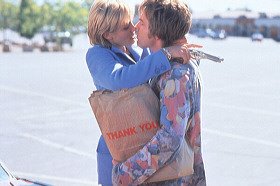
In essence, I suppose Danny Boyle's follow-up to his breakthrough hit Trainspotting is no different to the many other romantic thrillers we've seen through the years, but, unlike them, A Life Less Ordinary doesn't even retain the pretence of trying to hide it's inevitability: of course, we always know that the lead pairing will fall in love, whatever obstacles have been haphazardly placed in their way,but somehow screenwriter John Hodge's decision to advertise this fact from before we've even met these characters loses the magic that can, occasionally, be present in this type of film. No, Hodge makes his main supporting pair of characters two angels, O'Reilly (Holly Hunter) and Jackson (Delroy Lindo), who are charged by their boss Gabriel (Dan Hedaya) of making two people fall in love, or else: if they fail, they'll be stranded on earth. So, of course, in the rather wacky, slightly heightened reality of A Life Less Ordinary, the central pairing must fall in love, because now the price is doubled: not only will they be unhappy, but these two angels will be too.
So who are this central pairing, this inevitably lovelorn couple, and how, exactly, are they thrust together? Well, Robert (Ewan McGregor, in his third straight film for Boyle) is a lowly cleaner with aspirations to write a trashy novel (he repeatedly spins a lame yarn about the lovechild of Marilyn Monroe and Bobby Kennedy growing up and solving a great mystery), but when he's fired from his job and replaced with a robot, he charges in and points a gun at his rich boss Naville (Ian Holm), and the whole thing transpires so he ends up kidnapping the man's beautiful daughter Celine (Cameron Diaz). Of course, Robert proves a rather inept kidnapper, but no worries: Celine is so smooth and confident, and I suppose rebellious, that she ends up taking charge of her own kidnapping... for a share of the profits, of course.
Strangely, for a film both written and directed by men, A Life Less Ordinary proves itself to be an oddly feminist film. Of course, this came when it was fashionable for the world to participate in reverse-sexism, a world where women are notably more intelligent and confident than the men, no matter what. (I have no problem with equality, but the current sexism towards men simply seems driven by revenge, which can hardly be what the suffragettes were aiming for.) Celine is so balanced, so relaxed, so coolly manipulative that she rapidly takes charge of everything, showing Robert what to do, easily escaping from her ropes and even offering a rather silly but convincing excuse to a curious neighbour who comes calling on their hideout. And so it is in the angels' pairing: O'Reilly constantly shushes a rather foolish Jackson when they visit Neville under the guise of bounty hunters. If Hodge's script had been more crafty, more elegantly written, and more sensibly compiled, it might have progressed beyond the simplistic exteriors of it's characters and created a more original film. But everything in A Life Less Ordinary seems pointless. Why draft in capable (and, in Hunter's case, consistently brilliant) actors if you're not going to give them anything to work with? The angel subplot certainly adds a fantastical interest to the film, but it never gels with the film, and Lindo and Hunter are reduced to mugging shots and soulless characterizations because there's nothing there for them to enhance. The script ambles along aimlessly, taking needless divertions into bitty scenes like Celine's forceful bank robbery and their visit to Stanley Tucci's rather unbalanced dentist. When, eventually, the film drops the kidnapping guise altogether, it totally falls apart, reducing itself to cliched romantic melodramatics and flat scenes of Diaz sobbing in her car.
I'm not sure if A Life Less Ordinary wants us to believe that it's actually spiritual or not. The ridiculous climax certainly points towards it, but it's almost so unbelievable that it might all be a joke. I can't exactly say that A life Less Ordinary is predictable, but it's plot turns are so stupid that I'd almost rather it had been. The cast, all a perfectly capable lot, are by no means awful, but they just dart around, aimlessly and rather half-heartedly trying to bring anything to their parts. Looking at the film's IMDB page, the current comment of choice describes the film favorably as "whimiscal and wacky"- if only the whimsy were charming enough to get excited about. Grade: D
In essence, I suppose Danny Boyle's follow-up to his breakthrough hit Trainspotting is no different to the many other romantic thrillers we've seen through the years, but, unlike them, A Life Less Ordinary doesn't even retain the pretence of trying to hide it's inevitability: of course, we always know that the lead pairing will fall in love, whatever obstacles have been haphazardly placed in their way,but somehow screenwriter John Hodge's decision to advertise this fact from before we've even met these characters loses the magic that can, occasionally, be present in this type of film. No, Hodge makes his main supporting pair of characters two angels, O'Reilly (Holly Hunter) and Jackson (Delroy Lindo), who are charged by their boss Gabriel (Dan Hedaya) of making two people fall in love, or else: if they fail, they'll be stranded on earth. So, of course, in the rather wacky, slightly heightened reality of A Life Less Ordinary, the central pairing must fall in love, because now the price is doubled: not only will they be unhappy, but these two angels will be too.
So who are this central pairing, this inevitably lovelorn couple, and how, exactly, are they thrust together? Well, Robert (Ewan McGregor, in his third straight film for Boyle) is a lowly cleaner with aspirations to write a trashy novel (he repeatedly spins a lame yarn about the lovechild of Marilyn Monroe and Bobby Kennedy growing up and solving a great mystery), but when he's fired from his job and replaced with a robot, he charges in and points a gun at his rich boss Naville (Ian Holm), and the whole thing transpires so he ends up kidnapping the man's beautiful daughter Celine (Cameron Diaz). Of course, Robert proves a rather inept kidnapper, but no worries: Celine is so smooth and confident, and I suppose rebellious, that she ends up taking charge of her own kidnapping... for a share of the profits, of course.
Strangely, for a film both written and directed by men, A Life Less Ordinary proves itself to be an oddly feminist film. Of course, this came when it was fashionable for the world to participate in reverse-sexism, a world where women are notably more intelligent and confident than the men, no matter what. (I have no problem with equality, but the current sexism towards men simply seems driven by revenge, which can hardly be what the suffragettes were aiming for.) Celine is so balanced, so relaxed, so coolly manipulative that she rapidly takes charge of everything, showing Robert what to do, easily escaping from her ropes and even offering a rather silly but convincing excuse to a curious neighbour who comes calling on their hideout. And so it is in the angels' pairing: O'Reilly constantly shushes a rather foolish Jackson when they visit Neville under the guise of bounty hunters. If Hodge's script had been more crafty, more elegantly written, and more sensibly compiled, it might have progressed beyond the simplistic exteriors of it's characters and created a more original film. But everything in A Life Less Ordinary seems pointless. Why draft in capable (and, in Hunter's case, consistently brilliant) actors if you're not going to give them anything to work with? The angel subplot certainly adds a fantastical interest to the film, but it never gels with the film, and Lindo and Hunter are reduced to mugging shots and soulless characterizations because there's nothing there for them to enhance. The script ambles along aimlessly, taking needless divertions into bitty scenes like Celine's forceful bank robbery and their visit to Stanley Tucci's rather unbalanced dentist. When, eventually, the film drops the kidnapping guise altogether, it totally falls apart, reducing itself to cliched romantic melodramatics and flat scenes of Diaz sobbing in her car.
I'm not sure if A Life Less Ordinary wants us to believe that it's actually spiritual or not. The ridiculous climax certainly points towards it, but it's almost so unbelievable that it might all be a joke. I can't exactly say that A life Less Ordinary is predictable, but it's plot turns are so stupid that I'd almost rather it had been. The cast, all a perfectly capable lot, are by no means awful, but they just dart around, aimlessly and rather half-heartedly trying to bring anything to their parts. Looking at the film's IMDB page, the current comment of choice describes the film favorably as "whimiscal and wacky"- if only the whimsy were charming enough to get excited about. Grade: D
Thursday, September 14, 2006
Crank, Volver and The Portrait of a Lady
[Crank (Neveldine/Taylor, 2006): I'm sure Crank is being hilariously ironic about all the movies we've seen before that pander to male fantasies of violence and sexuality, and I'm sure that someone with a better humour than me can delight in mocking all those wet-dreams that Crank is simultaneously rolling in the irony of and delighting in. I'm sure that someone with a less easily overwhelmed state-of-mind finds Crank an endlessly exciting thrill-ride; I'm sure that that someone didn't find, contrary to reports, that Crank is actually remarkably slow, timing out at regular intervals and failing to give it's desired impression of a heart that must be kept running on high. I'm sure that someone who loves Speed less than I won't despise the obvious parallels with that truly high-octane thriller- I'm sure that someone will delight in saying that "Oh, but Crank's better than Speed, 'cause this time it's actually a person that has to keep his speed-limit up!". I'm sure that someone that lets things go more easily than I won't question the plausibility of having an English hit-man (Jason Statham) living so successfully in L.A., and with a gorgeous girlfriend (Amy Smart) to boot. I'm sure that someone actually likes Jason Statham, that someone doesn't see him as a symbol of everything that's wrong with this type of movie, that someone finds him charming and actually worth 88 minutes of screentime. I'm sure that someone doesn't question the word "fucking" in every single sentance in this movie, that, oh, it's just how they are, or that someone takes the idea that Crank exists in a heightened reality (a very heightened reality) excuses all the despicable nonsense that the directors force upon us.
But you know what? That someone ain't me. Grade: D+]
[Volver (Pedro Almodovar, 2006): I went straight from the "ironic" horrors of Crank into my real reason for being at the theatre that day, and it was a blissfully different experience. My limited experience of Almodovar stretches to just his last two movies- Talk to Her was an odd experience, but a surprisingly human and delicate study of male fantasies and their relationships with women, while Bad Education, while featuring a stunning performance by a sex-filled Gael Garcia Bernal, was more of a jumbled study of male sexuality. This time, Almodovar turns his attentions to women- indeed, there is only one male character of any note, and his screentime his little and portrayal very basic. But it had no need to be. This character serves only as a plot device, because here, it's all about the women. Penelope Cruz gives a knockout performance as Raimunda, self-sacrificing wife and mother who has seemingly given over her life to her family. I'm sure you know the basic plot outline- Raimunda and Sole's (Lola Duenas) dead mother (Carmen Maura) appears to Sole after their aunt (Chsu Lampreave) dies. What is so wonderful about Volver is how unpredictable it is (and on that note, I'll not spoil it, for the joy is in the discovery). Almost every scene is a perfectly observed look at female relationships and hardships. But what makes Almodovar's writing come to life is the efforts of the cast, who justly won an ensemble award at the Cannes film festival. While Cruz carries the film with a performance of startling depth and strenght, as a woman who appears to carry everyone but is ultimately in need of carrying herself, Maura gives a beautifully judged performance of impish cheek and weary hardship, and Duenas, given a more comic role, does wonders. Yoahana Cobo, as Cruz's daughter, is also a lively foil, sardonically countering her impulsive mother, and Blanca Portillo, as kindly, tired neighbour Agustina, does well with a more dramatic sub-plot. Ultimately, apart from one off-balance 'revelation' scene, Volver emerges as an uplifting, charming but also movingly poignant experience, a superb study of womanhood and the impact of death. See it as soon as you can. Grade: A-]
[The Portrait of a Lady (Jane Campion, 1996): Jane Campion's follow-up to the beloved The Piano came in for a lot of flack (although Nick Davis gives it a superb defense), but I found it a compelling, beautifully made, if occasionally problematic, period film. Campion opens with an unusually offbeat opening- modern-day Australian girls discussing their love of kissing- which serves as a striking way to open the film, presenting you with confident girls of today and then switching to Henry James' actual story for the confident girl of yesteryear. American Isabel Archer (Nicole Kidman) has just recieved a proposal from Lord Warburton (Richard E. Grant), which she refuses on the grounds that she wants to live and see the world before she marries. Her cousin Ralph Touchett (Martin Donovan), secretly in love with her, arranges for her to inherit a large fortune from his ailing father (John Gielgud), so that she can live out her dreams. Isabel travels to Florence, where she meets Gilbert Osmond (John Malkovich), a mysterious and seemingly rather reclusive widowed father to Pansy (Valentina Cervi). Thanks, it seems to the mysterious dealings of Madame Merle (Barbara Hershey), Isabel is persued by Osmond, and, after a year away in Egypt, she finds herself preoccupied with Osmond and agrees to marry him.
This only describes the first half of The Portrait of a Lady, and, indeed, the first half of the film is the more troublesome, for various reasons. Campion's directorial flair occasionally goes to far here, most notably in the short sequence portraying Isabel's travels in Egypt- presenting it as a 1930s-style news-reel, it features such bizarre and unnecessary oddities as talking kidney beans and a naked Kidman in the desert. The other major problem is Kidman- here she feels too often ill-at-ease, not comfortable playing a confident young woman too happy to realise her naiveity. Thankfully, the second half, as we jump three years into Isabel and Osmond's marriage, gives Kidman a more familiar part to her- a more downtrodden and depressed, weary woman who gradually becomes aware of her foolishness. Here, also, Campion's direction is more confident and useful- the shots, the movement is often exquisitely composed, combining to perfection with a deep blue and grey hues of Stuart Dryburgh's cinematography and portraying a disturbing glaciality that has come over everyone on-screen. Of all the performers, it is Hershey who gained the most accolades, and justly so: a delicate cocktail of deep-seated anger and sadness mixed with an outwardly courteous, affected manner.
Mary Ann Johanson criticized the film by saying it "is everything costume dramas always threaten to be"; but, in my eyes, The Portait of a Lady is everything that costume dramas usually aren't: visually daring, moody, and so cold it passes from the dangerous territory of dull into the more arresting territory of freezing transfixing. No, it is not perfect, but it's one of the best costume dramas you're likely to encounter, and once again proves that The Piano was thankfully no fluke for Campion. Grade: B+]
But you know what? That someone ain't me. Grade: D+]
[Volver (Pedro Almodovar, 2006): I went straight from the "ironic" horrors of Crank into my real reason for being at the theatre that day, and it was a blissfully different experience. My limited experience of Almodovar stretches to just his last two movies- Talk to Her was an odd experience, but a surprisingly human and delicate study of male fantasies and their relationships with women, while Bad Education, while featuring a stunning performance by a sex-filled Gael Garcia Bernal, was more of a jumbled study of male sexuality. This time, Almodovar turns his attentions to women- indeed, there is only one male character of any note, and his screentime his little and portrayal very basic. But it had no need to be. This character serves only as a plot device, because here, it's all about the women. Penelope Cruz gives a knockout performance as Raimunda, self-sacrificing wife and mother who has seemingly given over her life to her family. I'm sure you know the basic plot outline- Raimunda and Sole's (Lola Duenas) dead mother (Carmen Maura) appears to Sole after their aunt (Chsu Lampreave) dies. What is so wonderful about Volver is how unpredictable it is (and on that note, I'll not spoil it, for the joy is in the discovery). Almost every scene is a perfectly observed look at female relationships and hardships. But what makes Almodovar's writing come to life is the efforts of the cast, who justly won an ensemble award at the Cannes film festival. While Cruz carries the film with a performance of startling depth and strenght, as a woman who appears to carry everyone but is ultimately in need of carrying herself, Maura gives a beautifully judged performance of impish cheek and weary hardship, and Duenas, given a more comic role, does wonders. Yoahana Cobo, as Cruz's daughter, is also a lively foil, sardonically countering her impulsive mother, and Blanca Portillo, as kindly, tired neighbour Agustina, does well with a more dramatic sub-plot. Ultimately, apart from one off-balance 'revelation' scene, Volver emerges as an uplifting, charming but also movingly poignant experience, a superb study of womanhood and the impact of death. See it as soon as you can. Grade: A-]
[The Portrait of a Lady (Jane Campion, 1996): Jane Campion's follow-up to the beloved The Piano came in for a lot of flack (although Nick Davis gives it a superb defense), but I found it a compelling, beautifully made, if occasionally problematic, period film. Campion opens with an unusually offbeat opening- modern-day Australian girls discussing their love of kissing- which serves as a striking way to open the film, presenting you with confident girls of today and then switching to Henry James' actual story for the confident girl of yesteryear. American Isabel Archer (Nicole Kidman) has just recieved a proposal from Lord Warburton (Richard E. Grant), which she refuses on the grounds that she wants to live and see the world before she marries. Her cousin Ralph Touchett (Martin Donovan), secretly in love with her, arranges for her to inherit a large fortune from his ailing father (John Gielgud), so that she can live out her dreams. Isabel travels to Florence, where she meets Gilbert Osmond (John Malkovich), a mysterious and seemingly rather reclusive widowed father to Pansy (Valentina Cervi). Thanks, it seems to the mysterious dealings of Madame Merle (Barbara Hershey), Isabel is persued by Osmond, and, after a year away in Egypt, she finds herself preoccupied with Osmond and agrees to marry him.
This only describes the first half of The Portrait of a Lady, and, indeed, the first half of the film is the more troublesome, for various reasons. Campion's directorial flair occasionally goes to far here, most notably in the short sequence portraying Isabel's travels in Egypt- presenting it as a 1930s-style news-reel, it features such bizarre and unnecessary oddities as talking kidney beans and a naked Kidman in the desert. The other major problem is Kidman- here she feels too often ill-at-ease, not comfortable playing a confident young woman too happy to realise her naiveity. Thankfully, the second half, as we jump three years into Isabel and Osmond's marriage, gives Kidman a more familiar part to her- a more downtrodden and depressed, weary woman who gradually becomes aware of her foolishness. Here, also, Campion's direction is more confident and useful- the shots, the movement is often exquisitely composed, combining to perfection with a deep blue and grey hues of Stuart Dryburgh's cinematography and portraying a disturbing glaciality that has come over everyone on-screen. Of all the performers, it is Hershey who gained the most accolades, and justly so: a delicate cocktail of deep-seated anger and sadness mixed with an outwardly courteous, affected manner.
Mary Ann Johanson criticized the film by saying it "is everything costume dramas always threaten to be"; but, in my eyes, The Portait of a Lady is everything that costume dramas usually aren't: visually daring, moody, and so cold it passes from the dangerous territory of dull into the more arresting territory of freezing transfixing. No, it is not perfect, but it's one of the best costume dramas you're likely to encounter, and once again proves that The Piano was thankfully no fluke for Campion. Grade: B+]
Wednesday, September 13, 2006
Awards Season 2006: The Most Anticipated of the Rest of the Year
As the Toronto Film Festival unofficially marks the cinematic world's descent into the dark hell known commonly as awards season, I thought it was high time for my picks as the best to look forward to in the months ahead. Since it's only two days away, I won't be including my current "can't wait!" movie of the moment, The Black Dahlia, though I do hope with every fibre of my being that it lives up to my exceedingly high expectations. It currently occupies the desktop of my brand spanking new laptop, so it best be worth that honour.
Anyway, I scoured and scraped through the planned release dates, and I finally whittled it down to a grand total of 20 films that I simply can't wait to arrive at the multiplex, or, perhaps more preferably, the nearest art-house. These are the films I'd skip lectures to see (although let's hope it doesn't come to that)- these are the films I'd walk for an hour just to get to. These are my most anticipated of the rest of 2006.
Numbers 20-11
20. Marie Antoinette (Sofia Coppola) (release- UK & USA: 20th October)
Little more than a fattening confection (in the metaphorical sense), it seems, but what a gorgeous confection it looks like! Kirsten Dunst looks magnetic as the legendary French queen, who, from the looks of the trailer, gains the chagrin of her people as she has wild and frivolous parties. Infamously booed at Cannes, it has actually recieved some positive reaction, and, if it looks doubtful to recieve much awards traction, it should still be a fascinating experience.
19. Casino Royale (Martin Campbell) (release- UK & USA: 17th November)
Bond's back, blonde and, by the looks of it, better than ever. The trailers seem to promising a darker, rawer feel to the long series, and let's hope a return to Bond's beginnings mean a fresh start for the series itself. Daniel Craig looks a very promising choice, in my eyes.
18. Stranger than Fiction (Marc Forster) (release- UK: 1st December; USA: 10th November)
The concept is genius: a man hears the narration of what seems to be his own life, but when it seems to announce his death, he's forced to investigate. Will Ferrell? Let's hope he can tone himself down. The presence of stars like Emma Thompson (as the narrator) and Maggie Gyllenhaal should help.
17. Infamous (Douglas McGrath) (release- UK: TBC; USA: 13th October (limited))
Another Capote? Festival reports are saying this is just as good. Little-known British actor Toby Jones tackles the writer this time around, apparently focusing more on his sexuality and the attraction between him and murderer Perry Smith (hey look, it's Daniel Craig again!). Sandra Bullock is also getting positive buzz for her performance as Capote's best friend Harper Lee (the role that garnered Catherine Keener an Oscar nom last year).
16. Bug (William Friedkin) (release- UK: TBC; USA: 1st December (limited))
This fascinating-sounding adaptation of what sounds like an intense stageplay is from Exorcist director Friedkin, and stars Michael Shannon as a man who sees insects everywhere, and Ashley Judd as the woman who holds up with him. Hopefully this will be an uncompromising psychological piece, because that's what I like best. If it ever gets released here, of course.
15. Inland Empire (David Lynch) (release- TBC)
Lynch is always one to watch, whether it's a masterwork (Mulholland Drive) or a mystery (Lost Highway), and I'd be a fool it I didn't counter in this as one to watch. Lynch favourite Laura Dern and Mulholland star Justin Theroux are two actors who begin to confuse themselves with the roles they're playing. At a reported time of 172 minutes, will this transfix or will it bore? Let's hope it's released soon so we can find out.
14. Starter for Ten (Tom Vaughan) (release- UK: 13th October; USA- February TBC)
A terrific looking British film about James McAvoy in his first year at university. As someone who's about to start the experience himself, this should be an entertaining and insightful, and hopefully fun, look at someone who sounds a lot like me.
13. The Painted Veil (John Curran) (release- UK: TBC; USA: 19th January)
A delicious cast of Naomi Watts, Edward Norton, Liev Schreiber and Diana Rigg star in this adaptation of W. Somerset Maugham's novel, already adapted for Greta Garbo in the 1930s. I hope this isn't as stale and cold as Curran's previous film, We Don't Live Here Anymore, and hope the lack of buzz on it is just because no one's seen anything yet.
12. Scenes of a Sexual Nature (Ed Blum) (release- UK: 3rd November; USA: TBC)
This tiny little British film looks a tad slight- a cast of various couples on Hampstead Heath one afternoon- but it has a killer cast- Hugh Bonneville, Andrew Lincoln, Sophie Okonedo, Catherine Tate, Eileen Atkins, Gina McKee, Polly Walker and Ewan McGregor (playing gay once again)- and has been touted as an enjoyable affair.
11. The Last King of Scotland (Kevin MacDonald) (release- UK: 12th January; USA: TBC)
Idi Adim's regime as Ugandan dictator in the 1970s is the subject of this very positively recieved new film from Touching the Void director MacDonald, and Forest Whitaker is touted as a Best Actor nominee for his role as Adim. Looks fascinating.
And the Top 10:
10. Breaking and Entering (Anthony Minghella) (release- UK: 10th November; USA: 8th January (limited), Jan TBC elsewhere)
Minghella’s newest film looks like a more reticent, low-key affair than his previous efforts like The English Patient or The Talented Mr. Ripley, and unlike them it’s also not a period piece: instead, architect Jude Law is drawn to a young thief's refugee mother (Juliette Binoche), straining his relationship with girlfriend Robin Wright Penn. My excitement for this one rose considerably when Kris Tapley gave it a rave.
9. Apocalypto (Mel Gibson) (release- UK: 5th January; USA: 8th December)
After all Gibson's coverage in the media recently I'm surprised they're still pushing ahead with this one, but then they did put a shitload of money into it. I find the Mayans a distressingly untouched subject, and, although Gibson says this is more an action film than a thinking piece, it still looks terrific. I admire Gibson for sticking to his guns and making it in the Maya language, even if I don't admire him for his recent behaviour.
8. The Good German (Steven Soderbergh) (release- UK: 9th March; USA: 25th December)
What a Christmas present for you Americans! I'm pumped for the latest Soderbergh-Clooney collaboration for the simple fact that it's in black-and-white; and with Cate Blanchett and Tobey Maguire co-starring and an enticing plot mixture of mystery and romance, colour me excited. You've got long enough to do so, mind you- March 9th?!
7. Goya's Ghosts (Milos Forman) (release- UK & USA: TBC)
It seems Milos Forman's long awaited project is having trouble finding a US distributor, although whether this is because it's not very good- or perhaps too daring?- remains to be seen. Natalie Portman stars as the muse of Spanish painter Francisco Goya (Stellan Skarsgard) who is labelled an heretic by a monk (Javier Bardem). It sounds like juicy project, and certainly looks good from the few pictures released, and hopefully it will find release before it's too late for the awards season, which it should be a major contender in.
6. Paris, je t'aime (various) (release- UK & USA: TBC)
A jumble of 20 different stories, representing the 20 differing arrondissements of the romance capital of world (and the start of the title), each segment of this long-awaited film has been made by a different director, ranging from Alexander Payne to the Coen brothers and Olivier Assayas to Wes Craven, and they're all preoccupied with that fascinating subject: love. Stars including Natalie Portman, Gena Rowlands, Steve Buscemi, Nick Nolte, Maggie Gyllenhaal, Miranda Richardson and Juliette Binoche form the multi-national cast. I was so tempted to pop in and see this when in Paris earlier this year; let's hope I made the wise decision and it pops up with a release date soon.
5. Fur: An Imaginary Portrait of Diane Arbus (Steven Shainberg) (release- UK: 10th November; USA: 10th November (limited))
Nicole Kidman looks set to give another terrific performance as Diane Arbus, the artist who gained fame with her photographs of the marginalised people in the USA. The trailer shows a film with the same off-kilter edge as Shainberg's last film Secretary, and I hope that he's kept that same feeling that made Secretary's exploration of dark sexual behaviour so fascinating and interesting. Robert Downey Jr. co-stars as part of his renaissance.
4. Little Children (Todd Field) (release- UK: TBC; USA: 6th October)
After his emotionally devastating but ultimately rather distancing debut In The Bedroom, Todd Field here adapts an acclaimed novel about surburban adultery and parenthood, and has the rather indelible cast of directing Kate Winslet, yet again tipped for an Oscar nomination. The trailer is itself an expertly crafted piece of art, and it’s to be hoped the film follows suit. Reviews so far have been kind and cruel in equal measure, but the one thing they’ve all agreed on is Winslet’s wonderousness- and hey, if I’m going to sit through Flushed Away for her, I’ll most definitely sit through this.
3. Children of Men (Alfonso Cuaron) (release: UK: 22nd September; USA: 25th December (limited))
Due out very soon here in the UK, this has been promisingly moved to a December release in the US, and festival reports are saying that Cuaron’s dark-looking apocalyptic drama is one of the year’s best films. Starring a to-die-for cast of Julianne Moore, Clive Owen, Chiwetel Ejiofor and Michael Caine, it’s set about thirty years in the future, where women are mysteriously infertile and the youngest person on the planet, an eighteen year old, has just died. This looks exactly like my kind of film, and rest assured I’ll be seeing it as soon as I possibly can.
2. The Fountain (Darren Aronofsky) (release- UK: 16th February; USA: 22nd November)
Darren Aronofsky’s long-awaited follow-up to his 2000 effort Requiem For a Dream, and his first collaboration with partner Rachel Weisz, was infamously booed at it’s premiere in Venice, but reports say it received just as much applause, and I personally can’t wait to see this, a film which sounds like it could be, and indeed is, so many different things at once. A multi-angled sci-fi time-travelling romance, it stars Hugh Jackman (certainly the one to watch this year) as a man who travels centuries to try to save his dying wife (Weisz). The charismatic duo of Jackman and Weisz are already demonstrating from this clip that they’ll make a transfixing pair, and Aronofsky’s incomparable visual style is sure to make this an experience not to be missed.
1. The Nativity Story (Catherine Hardewicke) (release- UK & USA: 1st December)
Two years ago, Mel Gibson (see #9) tackled the bloody end of the life of Jesus Christ- this year, Thirteen director Catherine Hardewicke explores the beginning of it, with Keisha Castle Hughes, in her first major role since her stunning debut in 2003’s Whale Rider, starring as Mary, mother of the baby Jesus. It is bound to be fascinating to see a cinematic representation of what we’ve all seen so many times at junior schools, and I hope and assume that Hardewicke’s raw style from Thirteen will add an intriguing new dimension to the tale. Whether this’ll satisfy my strange, atheistic interest in the subject, we shall find out this Christmas.
Anyway, I scoured and scraped through the planned release dates, and I finally whittled it down to a grand total of 20 films that I simply can't wait to arrive at the multiplex, or, perhaps more preferably, the nearest art-house. These are the films I'd skip lectures to see (although let's hope it doesn't come to that)- these are the films I'd walk for an hour just to get to. These are my most anticipated of the rest of 2006.
Numbers 20-11
20. Marie Antoinette (Sofia Coppola) (release- UK & USA: 20th October)
Little more than a fattening confection (in the metaphorical sense), it seems, but what a gorgeous confection it looks like! Kirsten Dunst looks magnetic as the legendary French queen, who, from the looks of the trailer, gains the chagrin of her people as she has wild and frivolous parties. Infamously booed at Cannes, it has actually recieved some positive reaction, and, if it looks doubtful to recieve much awards traction, it should still be a fascinating experience.
19. Casino Royale (Martin Campbell) (release- UK & USA: 17th November)
Bond's back, blonde and, by the looks of it, better than ever. The trailers seem to promising a darker, rawer feel to the long series, and let's hope a return to Bond's beginnings mean a fresh start for the series itself. Daniel Craig looks a very promising choice, in my eyes.
18. Stranger than Fiction (Marc Forster) (release- UK: 1st December; USA: 10th November)
The concept is genius: a man hears the narration of what seems to be his own life, but when it seems to announce his death, he's forced to investigate. Will Ferrell? Let's hope he can tone himself down. The presence of stars like Emma Thompson (as the narrator) and Maggie Gyllenhaal should help.
17. Infamous (Douglas McGrath) (release- UK: TBC; USA: 13th October (limited))
Another Capote? Festival reports are saying this is just as good. Little-known British actor Toby Jones tackles the writer this time around, apparently focusing more on his sexuality and the attraction between him and murderer Perry Smith (hey look, it's Daniel Craig again!). Sandra Bullock is also getting positive buzz for her performance as Capote's best friend Harper Lee (the role that garnered Catherine Keener an Oscar nom last year).
16. Bug (William Friedkin) (release- UK: TBC; USA: 1st December (limited))
This fascinating-sounding adaptation of what sounds like an intense stageplay is from Exorcist director Friedkin, and stars Michael Shannon as a man who sees insects everywhere, and Ashley Judd as the woman who holds up with him. Hopefully this will be an uncompromising psychological piece, because that's what I like best. If it ever gets released here, of course.
15. Inland Empire (David Lynch) (release- TBC)
Lynch is always one to watch, whether it's a masterwork (Mulholland Drive) or a mystery (Lost Highway), and I'd be a fool it I didn't counter in this as one to watch. Lynch favourite Laura Dern and Mulholland star Justin Theroux are two actors who begin to confuse themselves with the roles they're playing. At a reported time of 172 minutes, will this transfix or will it bore? Let's hope it's released soon so we can find out.
14. Starter for Ten (Tom Vaughan) (release- UK: 13th October; USA- February TBC)
A terrific looking British film about James McAvoy in his first year at university. As someone who's about to start the experience himself, this should be an entertaining and insightful, and hopefully fun, look at someone who sounds a lot like me.
13. The Painted Veil (John Curran) (release- UK: TBC; USA: 19th January)
A delicious cast of Naomi Watts, Edward Norton, Liev Schreiber and Diana Rigg star in this adaptation of W. Somerset Maugham's novel, already adapted for Greta Garbo in the 1930s. I hope this isn't as stale and cold as Curran's previous film, We Don't Live Here Anymore, and hope the lack of buzz on it is just because no one's seen anything yet.
12. Scenes of a Sexual Nature (Ed Blum) (release- UK: 3rd November; USA: TBC)
This tiny little British film looks a tad slight- a cast of various couples on Hampstead Heath one afternoon- but it has a killer cast- Hugh Bonneville, Andrew Lincoln, Sophie Okonedo, Catherine Tate, Eileen Atkins, Gina McKee, Polly Walker and Ewan McGregor (playing gay once again)- and has been touted as an enjoyable affair.
11. The Last King of Scotland (Kevin MacDonald) (release- UK: 12th January; USA: TBC)
Idi Adim's regime as Ugandan dictator in the 1970s is the subject of this very positively recieved new film from Touching the Void director MacDonald, and Forest Whitaker is touted as a Best Actor nominee for his role as Adim. Looks fascinating.
And the Top 10:
10. Breaking and Entering (Anthony Minghella) (release- UK: 10th November; USA: 8th January (limited), Jan TBC elsewhere)
Minghella’s newest film looks like a more reticent, low-key affair than his previous efforts like The English Patient or The Talented Mr. Ripley, and unlike them it’s also not a period piece: instead, architect Jude Law is drawn to a young thief's refugee mother (Juliette Binoche), straining his relationship with girlfriend Robin Wright Penn. My excitement for this one rose considerably when Kris Tapley gave it a rave.
9. Apocalypto (Mel Gibson) (release- UK: 5th January; USA: 8th December)
After all Gibson's coverage in the media recently I'm surprised they're still pushing ahead with this one, but then they did put a shitload of money into it. I find the Mayans a distressingly untouched subject, and, although Gibson says this is more an action film than a thinking piece, it still looks terrific. I admire Gibson for sticking to his guns and making it in the Maya language, even if I don't admire him for his recent behaviour.
8. The Good German (Steven Soderbergh) (release- UK: 9th March; USA: 25th December)
What a Christmas present for you Americans! I'm pumped for the latest Soderbergh-Clooney collaboration for the simple fact that it's in black-and-white; and with Cate Blanchett and Tobey Maguire co-starring and an enticing plot mixture of mystery and romance, colour me excited. You've got long enough to do so, mind you- March 9th?!
7. Goya's Ghosts (Milos Forman) (release- UK & USA: TBC)
It seems Milos Forman's long awaited project is having trouble finding a US distributor, although whether this is because it's not very good- or perhaps too daring?- remains to be seen. Natalie Portman stars as the muse of Spanish painter Francisco Goya (Stellan Skarsgard) who is labelled an heretic by a monk (Javier Bardem). It sounds like juicy project, and certainly looks good from the few pictures released, and hopefully it will find release before it's too late for the awards season, which it should be a major contender in.
6. Paris, je t'aime (various) (release- UK & USA: TBC)
A jumble of 20 different stories, representing the 20 differing arrondissements of the romance capital of world (and the start of the title), each segment of this long-awaited film has been made by a different director, ranging from Alexander Payne to the Coen brothers and Olivier Assayas to Wes Craven, and they're all preoccupied with that fascinating subject: love. Stars including Natalie Portman, Gena Rowlands, Steve Buscemi, Nick Nolte, Maggie Gyllenhaal, Miranda Richardson and Juliette Binoche form the multi-national cast. I was so tempted to pop in and see this when in Paris earlier this year; let's hope I made the wise decision and it pops up with a release date soon.
5. Fur: An Imaginary Portrait of Diane Arbus (Steven Shainberg) (release- UK: 10th November; USA: 10th November (limited))
Nicole Kidman looks set to give another terrific performance as Diane Arbus, the artist who gained fame with her photographs of the marginalised people in the USA. The trailer shows a film with the same off-kilter edge as Shainberg's last film Secretary, and I hope that he's kept that same feeling that made Secretary's exploration of dark sexual behaviour so fascinating and interesting. Robert Downey Jr. co-stars as part of his renaissance.
4. Little Children (Todd Field) (release- UK: TBC; USA: 6th October)
After his emotionally devastating but ultimately rather distancing debut In The Bedroom, Todd Field here adapts an acclaimed novel about surburban adultery and parenthood, and has the rather indelible cast of directing Kate Winslet, yet again tipped for an Oscar nomination. The trailer is itself an expertly crafted piece of art, and it’s to be hoped the film follows suit. Reviews so far have been kind and cruel in equal measure, but the one thing they’ve all agreed on is Winslet’s wonderousness- and hey, if I’m going to sit through Flushed Away for her, I’ll most definitely sit through this.
3. Children of Men (Alfonso Cuaron) (release: UK: 22nd September; USA: 25th December (limited))
Due out very soon here in the UK, this has been promisingly moved to a December release in the US, and festival reports are saying that Cuaron’s dark-looking apocalyptic drama is one of the year’s best films. Starring a to-die-for cast of Julianne Moore, Clive Owen, Chiwetel Ejiofor and Michael Caine, it’s set about thirty years in the future, where women are mysteriously infertile and the youngest person on the planet, an eighteen year old, has just died. This looks exactly like my kind of film, and rest assured I’ll be seeing it as soon as I possibly can.
2. The Fountain (Darren Aronofsky) (release- UK: 16th February; USA: 22nd November)
Darren Aronofsky’s long-awaited follow-up to his 2000 effort Requiem For a Dream, and his first collaboration with partner Rachel Weisz, was infamously booed at it’s premiere in Venice, but reports say it received just as much applause, and I personally can’t wait to see this, a film which sounds like it could be, and indeed is, so many different things at once. A multi-angled sci-fi time-travelling romance, it stars Hugh Jackman (certainly the one to watch this year) as a man who travels centuries to try to save his dying wife (Weisz). The charismatic duo of Jackman and Weisz are already demonstrating from this clip that they’ll make a transfixing pair, and Aronofsky’s incomparable visual style is sure to make this an experience not to be missed.
1. The Nativity Story (Catherine Hardewicke) (release- UK & USA: 1st December)
Two years ago, Mel Gibson (see #9) tackled the bloody end of the life of Jesus Christ- this year, Thirteen director Catherine Hardewicke explores the beginning of it, with Keisha Castle Hughes, in her first major role since her stunning debut in 2003’s Whale Rider, starring as Mary, mother of the baby Jesus. It is bound to be fascinating to see a cinematic representation of what we’ve all seen so many times at junior schools, and I hope and assume that Hardewicke’s raw style from Thirteen will add an intriguing new dimension to the tale. Whether this’ll satisfy my strange, atheistic interest in the subject, we shall find out this Christmas.
Monday, September 11, 2006
Welcome to Sarajevo, Far From Heaven and Barry Lyndon
Some more thoughts on recent viewings.
[Welcome to Sarajevo (Michael Winterbottom, 1997): Sarajevo was a war that, unusually for Hollywood, was overlooked for exploration, perhaps because, as we see here, it was so inhuman and shocking. The raw recreation of bomb sights, with vivid shots of feet hanging by their veins and holes in victims' heads is unnerving, and perhaps a bit exploitative, but Winterbottom is clearly aiming to impact the viewer, and this he certainly achieves. The first half of this rather slow drama is the best: Winterbottom and his cast explore the media's coverage of the event, examining the differing approachs of American reporter Woody Harrelson and British one Stephen Dillane; however, the change to a more personal drama, as Dillane becomes emotionally involved with a young orphan (Emira Nusevic), doesn't work, either because of Dillane's stiff performance or simply because it seems too familiar. Threads like Marisa Tomei's aid worker and Goran Visnjic's (a stellar turn) native driver are more interesting, but ultimately disappointing because Winterbottom keeps focus on Dillane. Ultimately, an occasionally powerful drama, but it feels unfulfilled. Grade: B-]
[Far From Heaven (Todd Haynes, 2002): Haynes' takes his cue from Douglas Sirk's famously lush melodramas of the 1950s and adds a slightly more contemporary angle: he, unlike Sirk, can tackle issues like homosexuality and race head-on, instead of leaving them in the subtext. Julianne Moore is transfixing as the housewife whose perfect life crumbles when she discovers her husband Dennis Quaid with another man, and, in her turmoil, rather unwisely turns to her black gardener Dennis Haysbert for support. Haynes perfectly recreates the 1950s setting, and, with cinematographer Edward Lachman and Elmer Bernstein's melodramatically flowing score exquisitely echoing the period, he explores the vicious underbelly of 1950s with precision. Moore, Quaid and Haysbert, as well as Patricia Clarkson as Moore's "best friend" and Viola Davis as her maid, are all exceptional, convincingly of the period but also relevant to today's as well. Perhaps a little more could have been made of Quaid's side of the story, and ultimately the emotional impact isn't as great as one would hope, but all in all, a gripping, sad little story. Grade: B+]
[Barry Lyndon (Stanley Kubrick, 1975): As is usually the case with Kubrick, I think that Barry Lyndon needs to be seen on the big screen to be fully appreciated, because it seems that it's productional qualities far out-weigh it's narrative ones. Ryan O'Neal wobbles as the titular character, progressing from an Irish lad in love with his cousin to eventually marrying the widow of a lord and ruining his own life. The first half of Barry's story, as he ventures across countries as a deserter from the British and then Prussian armies, is quite compelling, as he encounters various characters (an interlude with Diana Koerner's abandoned wife is quite impressively melancholic), but when it settles into Barry's life with Lady Lyndon (a wasted Marisa Berenson) and his troubles with her son Lord Bullingdon (Leon Vitali) it starts to lose focus and indeed the audience's attention. Famous production designer Ken Adam's work is quite ravishing, but on a small screen it has little impact, and the attraction really remains a mystery. A fascinating oddity, nonetheless, with the highlight perhaps being Michael Hordern's sardonic narration. Grade: B-]
[Welcome to Sarajevo (Michael Winterbottom, 1997): Sarajevo was a war that, unusually for Hollywood, was overlooked for exploration, perhaps because, as we see here, it was so inhuman and shocking. The raw recreation of bomb sights, with vivid shots of feet hanging by their veins and holes in victims' heads is unnerving, and perhaps a bit exploitative, but Winterbottom is clearly aiming to impact the viewer, and this he certainly achieves. The first half of this rather slow drama is the best: Winterbottom and his cast explore the media's coverage of the event, examining the differing approachs of American reporter Woody Harrelson and British one Stephen Dillane; however, the change to a more personal drama, as Dillane becomes emotionally involved with a young orphan (Emira Nusevic), doesn't work, either because of Dillane's stiff performance or simply because it seems too familiar. Threads like Marisa Tomei's aid worker and Goran Visnjic's (a stellar turn) native driver are more interesting, but ultimately disappointing because Winterbottom keeps focus on Dillane. Ultimately, an occasionally powerful drama, but it feels unfulfilled. Grade: B-]
[Far From Heaven (Todd Haynes, 2002): Haynes' takes his cue from Douglas Sirk's famously lush melodramas of the 1950s and adds a slightly more contemporary angle: he, unlike Sirk, can tackle issues like homosexuality and race head-on, instead of leaving them in the subtext. Julianne Moore is transfixing as the housewife whose perfect life crumbles when she discovers her husband Dennis Quaid with another man, and, in her turmoil, rather unwisely turns to her black gardener Dennis Haysbert for support. Haynes perfectly recreates the 1950s setting, and, with cinematographer Edward Lachman and Elmer Bernstein's melodramatically flowing score exquisitely echoing the period, he explores the vicious underbelly of 1950s with precision. Moore, Quaid and Haysbert, as well as Patricia Clarkson as Moore's "best friend" and Viola Davis as her maid, are all exceptional, convincingly of the period but also relevant to today's as well. Perhaps a little more could have been made of Quaid's side of the story, and ultimately the emotional impact isn't as great as one would hope, but all in all, a gripping, sad little story. Grade: B+]
[Barry Lyndon (Stanley Kubrick, 1975): As is usually the case with Kubrick, I think that Barry Lyndon needs to be seen on the big screen to be fully appreciated, because it seems that it's productional qualities far out-weigh it's narrative ones. Ryan O'Neal wobbles as the titular character, progressing from an Irish lad in love with his cousin to eventually marrying the widow of a lord and ruining his own life. The first half of Barry's story, as he ventures across countries as a deserter from the British and then Prussian armies, is quite compelling, as he encounters various characters (an interlude with Diana Koerner's abandoned wife is quite impressively melancholic), but when it settles into Barry's life with Lady Lyndon (a wasted Marisa Berenson) and his troubles with her son Lord Bullingdon (Leon Vitali) it starts to lose focus and indeed the audience's attention. Famous production designer Ken Adam's work is quite ravishing, but on a small screen it has little impact, and the attraction really remains a mystery. A fascinating oddity, nonetheless, with the highlight perhaps being Michael Hordern's sardonic narration. Grade: B-]
The Deep End, Light in the Piazza and Snow Cake
Some thoughts on recent viewings:
[The Deep End (Scott McGehee & David Siegel, 2001): A remake of Max Ophuls' 1949 film The Reckless Moment, this alternative version of Elisabeth Sanxay Holding's novel of secrets and blackmail is clearly aiming for the type of feeling I love in my thrillers: slow-burning, gradually created thrills. But the story seems so predictable, and the characters so trite, that it's difficult to get involved. Tilda Swinton gives a solid, if frosty performance as a mother who is desperate to hide her oldest son's budding homosexuality, an aim made difficult when his lover (a short role for an impressively creepy Josh Lucas) is accidentally killed at their lake-side Taho home, and then a blackmailer (Goran Visnjic) turns up with a tape showing the pair en flagrante and a demand of $50,000. McGehee and Siegel draw an impressive desperation in Swinton's attempts to balance the demands of this blackmailing and Visnjic's increasing attention to her with the day-to-day tasks of a mother, but the thriller elements of the film fail on almost every count, and it's not helped at all by the story's strong inclinations towards romantic attraction between Swinton and Visnjic. There's a surprisingly engaging performance from young Jonathan Tucker as the aforementioned son, but the story never has a strong enough pull and the cast don't seem to be able to overcome it. McGehee and Siegel fared much better four years later with their enormously underrated Bee Season, which also turned it's attentions towards family life but was thankfully free of any attempts to thrill. Grade: C+]
[Light in the Piazza (Guy Green, 1962): This adaptation of Elisabeth Spencer's book is a strange concuction, framing it's entire story on an accident we never witness and then almost refusing to answer it's implications at all. An weary-looking Olivia de Havilland is fantastic as Meg Johnston, a wealthy American staying in Florence with her daughter Clara (Yvette Mimieux), whom she has taken away from the distractions of American boys because, as we quickly discover, Clara fell off her pony at a young age and is stuck with the mental age of 10. Nevertheless, her natural beauty soon attracts the attentions of a wealthy local boy, played by the much derided American George Hamilton in a highly convincing performance (complete with accent), and they fall in love. Meg is, of course, worried about this development, but, as she begins to see the possible realisation of her fantasy for her daughter, she stumbles and is reluctant to force them apart. This little seen film clearly wants you to embed yourself in it's more unusual dramatic elements, and indeed, interludes like the visit of Clara's father show us the darker effects of Clara's mental state, but ultimately it's just a sweet little romance and on this level, it succeeds. Mimieux and Hamilton make a charming pairing and it's almost impossible not to get swept up in the situation, especially with such a talent as de Hallivand to keep you watching. Perhaps the ultimate glossing over of what was for most of the film the central dilemma is a bit worrying, but this a pleasant, nicely shot and well performed film that would serve well for a Saturday afternoon. Grade: B-]
[Snow Cake (Marc Evans, 2006): This effort from Welsh director Marc Evans was financed entirely by the UK and Canada, and this low-budget, under-the-radar situation is perhaps, and unfortunately, going to lead to the overlooking of it's star Sigourney Weaver once again come awards season. This film rests pretty much on her shoulders, as she beautifully plays autistic woman Linda Freeman, whose response to a consolation on her daughter's death is a straightforward "I haven't lost her, she's dead", shocking the woman who offered this softened apology in the first place. Ostentatiously, I suppose, Snow Cake is about Alex Hughes, played by a subdued and uneven Alan Rickman, who was giving Linda's daughter (a bright Emily Hampshire) a lift when a truck hits the car and kills her but leaves him virtually unmarked. His guilt leads him to her mother's home, where her offbeat approach to human engagement leads to him staying with her until after the funeral. The film's strenght comes in the relationship between Weaver and Rickman, which, due to Linda's autism is constantly surprising and unpredictable, and often remarkably charming (in scenes such as Linda's "comic-book Scrabble"). Evans, or rather screenwriter Angela Pell trips herself up with an unnecessary subplot involving Rickman's involvement with Weaver's neighbour Carrie-Anne Moss (in a pleasant and natural but totally unneeded performance), and with the revelations involving Rickman's damaged past, but Weaver's performance is a marvel and alone makes the film worth the price of admission. Given a more approachable form of autism than Dustin Hoffman's famous role, she could easily coast through the role, but each moment is invested with a weighty darkness, unlikely coupled with a delightful child-like exterior. Grade: B]
[The Deep End (Scott McGehee & David Siegel, 2001): A remake of Max Ophuls' 1949 film The Reckless Moment, this alternative version of Elisabeth Sanxay Holding's novel of secrets and blackmail is clearly aiming for the type of feeling I love in my thrillers: slow-burning, gradually created thrills. But the story seems so predictable, and the characters so trite, that it's difficult to get involved. Tilda Swinton gives a solid, if frosty performance as a mother who is desperate to hide her oldest son's budding homosexuality, an aim made difficult when his lover (a short role for an impressively creepy Josh Lucas) is accidentally killed at their lake-side Taho home, and then a blackmailer (Goran Visnjic) turns up with a tape showing the pair en flagrante and a demand of $50,000. McGehee and Siegel draw an impressive desperation in Swinton's attempts to balance the demands of this blackmailing and Visnjic's increasing attention to her with the day-to-day tasks of a mother, but the thriller elements of the film fail on almost every count, and it's not helped at all by the story's strong inclinations towards romantic attraction between Swinton and Visnjic. There's a surprisingly engaging performance from young Jonathan Tucker as the aforementioned son, but the story never has a strong enough pull and the cast don't seem to be able to overcome it. McGehee and Siegel fared much better four years later with their enormously underrated Bee Season, which also turned it's attentions towards family life but was thankfully free of any attempts to thrill. Grade: C+]
[Light in the Piazza (Guy Green, 1962): This adaptation of Elisabeth Spencer's book is a strange concuction, framing it's entire story on an accident we never witness and then almost refusing to answer it's implications at all. An weary-looking Olivia de Havilland is fantastic as Meg Johnston, a wealthy American staying in Florence with her daughter Clara (Yvette Mimieux), whom she has taken away from the distractions of American boys because, as we quickly discover, Clara fell off her pony at a young age and is stuck with the mental age of 10. Nevertheless, her natural beauty soon attracts the attentions of a wealthy local boy, played by the much derided American George Hamilton in a highly convincing performance (complete with accent), and they fall in love. Meg is, of course, worried about this development, but, as she begins to see the possible realisation of her fantasy for her daughter, she stumbles and is reluctant to force them apart. This little seen film clearly wants you to embed yourself in it's more unusual dramatic elements, and indeed, interludes like the visit of Clara's father show us the darker effects of Clara's mental state, but ultimately it's just a sweet little romance and on this level, it succeeds. Mimieux and Hamilton make a charming pairing and it's almost impossible not to get swept up in the situation, especially with such a talent as de Hallivand to keep you watching. Perhaps the ultimate glossing over of what was for most of the film the central dilemma is a bit worrying, but this a pleasant, nicely shot and well performed film that would serve well for a Saturday afternoon. Grade: B-]
[Snow Cake (Marc Evans, 2006): This effort from Welsh director Marc Evans was financed entirely by the UK and Canada, and this low-budget, under-the-radar situation is perhaps, and unfortunately, going to lead to the overlooking of it's star Sigourney Weaver once again come awards season. This film rests pretty much on her shoulders, as she beautifully plays autistic woman Linda Freeman, whose response to a consolation on her daughter's death is a straightforward "I haven't lost her, she's dead", shocking the woman who offered this softened apology in the first place. Ostentatiously, I suppose, Snow Cake is about Alex Hughes, played by a subdued and uneven Alan Rickman, who was giving Linda's daughter (a bright Emily Hampshire) a lift when a truck hits the car and kills her but leaves him virtually unmarked. His guilt leads him to her mother's home, where her offbeat approach to human engagement leads to him staying with her until after the funeral. The film's strenght comes in the relationship between Weaver and Rickman, which, due to Linda's autism is constantly surprising and unpredictable, and often remarkably charming (in scenes such as Linda's "comic-book Scrabble"). Evans, or rather screenwriter Angela Pell trips herself up with an unnecessary subplot involving Rickman's involvement with Weaver's neighbour Carrie-Anne Moss (in a pleasant and natural but totally unneeded performance), and with the revelations involving Rickman's damaged past, but Weaver's performance is a marvel and alone makes the film worth the price of admission. Given a more approachable form of autism than Dustin Hoffman's famous role, she could easily coast through the role, but each moment is invested with a weighty darkness, unlikely coupled with a delightful child-like exterior. Grade: B]
Subscribe to:
Comments (Atom)