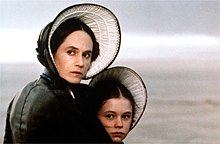
Jane Campion's The Piano is one of those rare, wonderful films that not only stands up to repeated viewings, but it gets better every time, never losing its power but somehow building on it. The infamous 'finger' scene is, on first viewing, perhaps simply sickening, but on a third I found it deeply unsettling, and a rapidly-following fourth viewing led me to actually weep while I watched it. Campion takes the traditional genre of a melodrama, or perhaps more specifically a 'woman's picture', and bends it, almost pulling a veil over your eyes, so that it's never really recognisable as such. Her dextrous visual style makes the film flow with an unsettling lucidity, both fitting in and standing incongruously with the narrative. Campion has said that she wanted the film to seem as if it were taking place underwater- hence the moody blue-green photography, but the sense of drowning is a constant one, as Holly Hunter's Ada McGrath tries to surface from the barren, dull landscape of the muddy New Zealand hills and her marriage to the simply-minded Sam Neill, whose failing to understand Ada's relationship to both her piano and her daughter (Anna Paquin) proves to be his undoing. If the stereotyping of the Aboriginals perhaps seems a bit racist, look again: yes, Campion's script does paint them as naive, inexperienced foreigners, but then this is a film from the perspective of the colonizers, not the colonized- to Ada, and indeed Neill's Stewart, the Aboriginals are strange and perhaps stupid, but at least they fit blissfully into the nature around them, something Ada struggles valiantly to do and that Stewart is so jealous of, perhaps, or more fittingly unable to comprehend, that he cuts it down and builds barriers within it. I, for one, know I love a film when I can pick out specific moments of performance or visual style that I love: here, I love the way the square-on camera loses its breath along with Ada when Stewart jumps out from behind a tree; I love Paquin's fiery delivery of the line "To hell!"; I love Paquin's galling sobs after the 'finger' scene; I love Hunter's smile to herself when Baines (Harvey Keitel) walks out of the village hall;... . The performances of The Piano are so deeply seated within it, so different in style yet so perfectly fit together; the style is creepily moody yet beautifully flowing; the music is rythmic yet unsettled; everything about it might seem initially unwielding, but Campion weaves a beautiful tapestry out of all these different elements, creating a film that is at once deeply haunting and deeply satisfying. It leave you with the idea that in the days, like Ada, you will feel happy and contented with it; but at night, when only the darkness surrounds you, you will be haunted by the unease of the film, the complexities of its emotion, and the contradictions seeping through its every pore. Grade: A
Showing posts with label Holly Hunter. Show all posts
Tuesday, November 21, 2006
Wednesday, September 20, 2006
A Life Less Ordinary
A Life Less Ordinary (Danny Boyle, 1997)

In essence, I suppose Danny Boyle's follow-up to his breakthrough hit Trainspotting is no different to the many other romantic thrillers we've seen through the years, but, unlike them, A Life Less Ordinary doesn't even retain the pretence of trying to hide it's inevitability: of course, we always know that the lead pairing will fall in love, whatever obstacles have been haphazardly placed in their way,but somehow screenwriter John Hodge's decision to advertise this fact from before we've even met these characters loses the magic that can, occasionally, be present in this type of film. No, Hodge makes his main supporting pair of characters two angels, O'Reilly (Holly Hunter) and Jackson (Delroy Lindo), who are charged by their boss Gabriel (Dan Hedaya) of making two people fall in love, or else: if they fail, they'll be stranded on earth. So, of course, in the rather wacky, slightly heightened reality of A Life Less Ordinary, the central pairing must fall in love, because now the price is doubled: not only will they be unhappy, but these two angels will be too.
So who are this central pairing, this inevitably lovelorn couple, and how, exactly, are they thrust together? Well, Robert (Ewan McGregor, in his third straight film for Boyle) is a lowly cleaner with aspirations to write a trashy novel (he repeatedly spins a lame yarn about the lovechild of Marilyn Monroe and Bobby Kennedy growing up and solving a great mystery), but when he's fired from his job and replaced with a robot, he charges in and points a gun at his rich boss Naville (Ian Holm), and the whole thing transpires so he ends up kidnapping the man's beautiful daughter Celine (Cameron Diaz). Of course, Robert proves a rather inept kidnapper, but no worries: Celine is so smooth and confident, and I suppose rebellious, that she ends up taking charge of her own kidnapping... for a share of the profits, of course.
Strangely, for a film both written and directed by men, A Life Less Ordinary proves itself to be an oddly feminist film. Of course, this came when it was fashionable for the world to participate in reverse-sexism, a world where women are notably more intelligent and confident than the men, no matter what. (I have no problem with equality, but the current sexism towards men simply seems driven by revenge, which can hardly be what the suffragettes were aiming for.) Celine is so balanced, so relaxed, so coolly manipulative that she rapidly takes charge of everything, showing Robert what to do, easily escaping from her ropes and even offering a rather silly but convincing excuse to a curious neighbour who comes calling on their hideout. And so it is in the angels' pairing: O'Reilly constantly shushes a rather foolish Jackson when they visit Neville under the guise of bounty hunters. If Hodge's script had been more crafty, more elegantly written, and more sensibly compiled, it might have progressed beyond the simplistic exteriors of it's characters and created a more original film. But everything in A Life Less Ordinary seems pointless. Why draft in capable (and, in Hunter's case, consistently brilliant) actors if you're not going to give them anything to work with? The angel subplot certainly adds a fantastical interest to the film, but it never gels with the film, and Lindo and Hunter are reduced to mugging shots and soulless characterizations because there's nothing there for them to enhance. The script ambles along aimlessly, taking needless divertions into bitty scenes like Celine's forceful bank robbery and their visit to Stanley Tucci's rather unbalanced dentist. When, eventually, the film drops the kidnapping guise altogether, it totally falls apart, reducing itself to cliched romantic melodramatics and flat scenes of Diaz sobbing in her car.
I'm not sure if A Life Less Ordinary wants us to believe that it's actually spiritual or not. The ridiculous climax certainly points towards it, but it's almost so unbelievable that it might all be a joke. I can't exactly say that A life Less Ordinary is predictable, but it's plot turns are so stupid that I'd almost rather it had been. The cast, all a perfectly capable lot, are by no means awful, but they just dart around, aimlessly and rather half-heartedly trying to bring anything to their parts. Looking at the film's IMDB page, the current comment of choice describes the film favorably as "whimiscal and wacky"- if only the whimsy were charming enough to get excited about. Grade: D

In essence, I suppose Danny Boyle's follow-up to his breakthrough hit Trainspotting is no different to the many other romantic thrillers we've seen through the years, but, unlike them, A Life Less Ordinary doesn't even retain the pretence of trying to hide it's inevitability: of course, we always know that the lead pairing will fall in love, whatever obstacles have been haphazardly placed in their way,but somehow screenwriter John Hodge's decision to advertise this fact from before we've even met these characters loses the magic that can, occasionally, be present in this type of film. No, Hodge makes his main supporting pair of characters two angels, O'Reilly (Holly Hunter) and Jackson (Delroy Lindo), who are charged by their boss Gabriel (Dan Hedaya) of making two people fall in love, or else: if they fail, they'll be stranded on earth. So, of course, in the rather wacky, slightly heightened reality of A Life Less Ordinary, the central pairing must fall in love, because now the price is doubled: not only will they be unhappy, but these two angels will be too.
So who are this central pairing, this inevitably lovelorn couple, and how, exactly, are they thrust together? Well, Robert (Ewan McGregor, in his third straight film for Boyle) is a lowly cleaner with aspirations to write a trashy novel (he repeatedly spins a lame yarn about the lovechild of Marilyn Monroe and Bobby Kennedy growing up and solving a great mystery), but when he's fired from his job and replaced with a robot, he charges in and points a gun at his rich boss Naville (Ian Holm), and the whole thing transpires so he ends up kidnapping the man's beautiful daughter Celine (Cameron Diaz). Of course, Robert proves a rather inept kidnapper, but no worries: Celine is so smooth and confident, and I suppose rebellious, that she ends up taking charge of her own kidnapping... for a share of the profits, of course.
Strangely, for a film both written and directed by men, A Life Less Ordinary proves itself to be an oddly feminist film. Of course, this came when it was fashionable for the world to participate in reverse-sexism, a world where women are notably more intelligent and confident than the men, no matter what. (I have no problem with equality, but the current sexism towards men simply seems driven by revenge, which can hardly be what the suffragettes were aiming for.) Celine is so balanced, so relaxed, so coolly manipulative that she rapidly takes charge of everything, showing Robert what to do, easily escaping from her ropes and even offering a rather silly but convincing excuse to a curious neighbour who comes calling on their hideout. And so it is in the angels' pairing: O'Reilly constantly shushes a rather foolish Jackson when they visit Neville under the guise of bounty hunters. If Hodge's script had been more crafty, more elegantly written, and more sensibly compiled, it might have progressed beyond the simplistic exteriors of it's characters and created a more original film. But everything in A Life Less Ordinary seems pointless. Why draft in capable (and, in Hunter's case, consistently brilliant) actors if you're not going to give them anything to work with? The angel subplot certainly adds a fantastical interest to the film, but it never gels with the film, and Lindo and Hunter are reduced to mugging shots and soulless characterizations because there's nothing there for them to enhance. The script ambles along aimlessly, taking needless divertions into bitty scenes like Celine's forceful bank robbery and their visit to Stanley Tucci's rather unbalanced dentist. When, eventually, the film drops the kidnapping guise altogether, it totally falls apart, reducing itself to cliched romantic melodramatics and flat scenes of Diaz sobbing in her car.
I'm not sure if A Life Less Ordinary wants us to believe that it's actually spiritual or not. The ridiculous climax certainly points towards it, but it's almost so unbelievable that it might all be a joke. I can't exactly say that A life Less Ordinary is predictable, but it's plot turns are so stupid that I'd almost rather it had been. The cast, all a perfectly capable lot, are by no means awful, but they just dart around, aimlessly and rather half-heartedly trying to bring anything to their parts. Looking at the film's IMDB page, the current comment of choice describes the film favorably as "whimiscal and wacky"- if only the whimsy were charming enough to get excited about. Grade: D
Subscribe to:
Posts (Atom)