[
Crank (Neveldine/Taylor, 2006): I'm sure
Crank is being hilariously ironic about all the movies we've seen before that pander to male fantasies of violence and sexuality, and I'm sure that someone with a better humour than me can delight in mocking all those wet-dreams that
Crank is simultaneously rolling in the irony of and delighting in. I'm sure that someone with a less easily overwhelmed state-of-mind finds
Crank an endlessly exciting thrill-ride; I'm sure that that someone didn't find, contrary to reports, that
Crank is actually remarkably slow, timing out at regular intervals and failing to give it's desired impression of a heart that must be kept running on high. I'm sure that someone who loves
Speed less than I won't despise the obvious parallels with that truly high-octane thriller- I'm sure that someone will delight in saying that "Oh, but
Crank's better than
Speed, 'cause this time it's actually a person that has to keep his speed-limit up!". I'm sure that someone that lets things go more easily than I won't question the plausibility of having an English hit-man (Jason Statham) living so successfully in L.A., and with a gorgeous girlfriend (Amy Smart) to boot. I'm sure that someone actually likes Jason Statham, that someone doesn't see him as a symbol of everything that's wrong with this type of movie, that someone finds him charming and actually worth 88 minutes of screentime. I'm sure that someone doesn't question the word "fucking" in
every single sentance in this movie, that, oh, it's just how they are, or that someone takes the idea that
Crank exists in a heightened reality (a very heightened reality) excuses all the despicable nonsense that the directors force upon us.
But you know what? That someone ain't me.
Grade: D+]
[
Volver (Pedro Almodovar, 2006): I went straight from the "ironic" horrors of
Crank into my real reason for being at the theatre that day, and it was a blissfully different experience. My limited experience of Almodovar stretches to just his last two movies-
Talk to Her was an odd experience, but a surprisingly human and delicate study of male fantasies and their relationships with women, while
Bad Education, while featuring a stunning performance by a sex-filled Gael Garcia Bernal, was more of a jumbled study of male sexuality. This time, Almodovar turns his attentions to women- indeed, there is only one male character of any note, and his screentime his little and portrayal very basic. But it had no need to be. This character serves only as a plot device, because here, it's all about the women. Penelope Cruz gives a knockout performance as Raimunda, self-sacrificing wife and mother who has seemingly given over her life to her family. I'm sure you know the basic plot outline- Raimunda and Sole's (Lola Duenas) dead mother (Carmen Maura) appears to Sole after their aunt (Chsu Lampreave) dies. What is so wonderful about
Volver is how unpredictable it is (and on that note, I'll not spoil it, for the joy is in the discovery). Almost every scene is a perfectly observed look at female relationships and hardships. But what makes Almodovar's writing come to life is the efforts of the cast, who justly won an ensemble award at the Cannes film festival. While Cruz carries the film with a performance of startling depth and strenght, as a woman who appears to carry everyone but is ultimately in need of carrying herself, Maura gives a beautifully judged performance of impish cheek and weary hardship, and Duenas, given a more comic role, does wonders. Yoahana Cobo, as Cruz's daughter, is also a lively foil, sardonically countering her impulsive mother, and Blanca Portillo, as kindly, tired neighbour Agustina, does well with a more dramatic sub-plot. Ultimately, apart from one off-balance 'revelation' scene,
Volver emerges as an uplifting, charming but also movingly poignant experience, a superb study of womanhood and the impact of death. See it as soon as you can.
Grade: A-]
[
The Portrait of a Lady (Jane Campion, 1996): Jane Campion's follow-up to the beloved
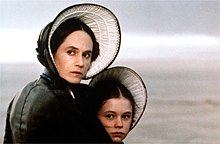
The Piano came in for a lot of flack (although Nick Davis gives it a superb
defense), but I found it a compelling, beautifully made, if occasionally problematic, period film. Campion opens with an unusually offbeat opening- modern-day Australian girls discussing their love of kissing- which serves as a striking way to open the film, presenting you with confident girls of today and then switching to Henry James' actual story for the confident girl of yesteryear. American Isabel Archer (Nicole Kidman) has just recieved a proposal from Lord Warburton (Richard E. Grant), which she refuses on the grounds that she wants to live and see the world before she marries. Her cousin Ralph Touchett (Martin Donovan), secretly in love with her, arranges for her to inherit a large fortune from his ailing father (John Gielgud), so that she can live out her dreams. Isabel travels to Florence, where she meets Gilbert Osmond (John Malkovich), a mysterious and seemingly rather reclusive widowed father to Pansy (Valentina Cervi). Thanks, it seems to the mysterious dealings of Madame Merle (Barbara Hershey), Isabel is persued by Osmond, and, after a year away in Egypt, she finds herself preoccupied with Osmond and agrees to marry him.
This only describes the first half of
The Portrait of a Lady, and, indeed, the first half of the film is the more troublesome, for various reasons. Campion's directorial flair occasionally goes to far here, most notably in the short sequence portraying Isabel's travels in Egypt- presenting it as a 1930s-style news-reel, it features such bizarre and unnecessary oddities as talking kidney beans and a naked Kidman in the desert. The other major problem is Kidman- here she feels too often ill-at-ease, not comfortable playing a confident young woman too happy to realise her naiveity. Thankfully, the second half, as we jump three years into Isabel and Osmond's marriage, gives Kidman a more familiar part to her- a more downtrodden and depressed, weary woman who gradually becomes aware of her foolishness. Here, also, Campion's direction is more confident and useful- the shots, the movement is often exquisitely composed, combining to perfection with a deep blue and grey hues of Stuart Dryburgh's cinematography and portraying a disturbing glaciality that has come over everyone on-screen. Of all the performers, it is Hershey who gained the most accolades, and justly so: a delicate cocktail of deep-seated anger and sadness mixed with an outwardly courteous, affected manner.
Mary Ann Johanson criticized the film by saying it "is everything costume dramas always threaten to be"; but, in my eyes,
The Portait of a Lady is everything that costume dramas usually aren't: visually daring, moody, and so cold it passes from the dangerous territory of dull into the more arresting territory of freezing transfixing. No, it is not perfect, but it's one of the best costume dramas you're likely to encounter, and once again proves that
The Piano was thankfully no fluke for Campion.
Grade: B+]

 The Piano (Jane Campion, 1993)