Sunday, February 27, 2011

Stone the crows

This blog hasn't been as busy as I'd like it to be, for however many reasons you'd like me to give, but intermittent silence doesn't mean I haven't been doing anything at all. If you follow me on Twitter (which if you're reading this you probably do), you'll hopefully already know about this, but I was waiting until I'd filled it out to a certain level of value before I made this 'official' post declaring it to all and sundry. Recently, I redesigned my sister blog, which is basically just an archive of every single movie I've ever seen, graded and categorized by year - it looks a lot cleaner and more streamlined now, don't you think?

Glad you approve, Emma!
In the process- inspired, as I often am, by Nick of Nick's Flick Picks, I took advantage of Blogger's new Page feature to add a little spice to that collection of lists: a 'Best Actress' page. Despite the proximity of me rambling on about all this so close to this year's Oscar ceremony - down with The King's Speech!, etc. - this page has nothing to do with the Oscars. What it is, simply, is my own personal picks for the best lead actress performance of each year. What you'll see currently goes back to 1990, with my top pick for each year and other must-see performances in parentheses beneath those. What you'll also see is write-ups of some of those. Today, on the eve of Oscar, and with my 2010 viewings slowly drawing to a close, I sealed the deal on that year and scrawled some thoughts on the marvellous Emma Stone.
Stone has a physicality seemingly designed for comedy - she provokes laughs from her wide-eyed cartoonish expressions to the smallest raise of an eyebrow, the lowest enunciations into Melanie Bostic's ear to a short, regretful reverie about Judy Bloom. The sheer scope of her comic arsenal is exercised throughout Easy A, because she recognises where the scrappy script needs a lift, or where she needs to give her scene partner room to have their moment, or where she can grab at some of the sharp one-liners and make them even funnier than they read.
It's no surprise that Emma didn't get a foot in the door with the Academy - she was lucky to land that seat at the Globes, what with Angelina Jolie hanging around - but her performance, to be slightly cliched here, is its own reward. As are all my chosen performances, recognised or not. So go forth, and read about Laura Linney's effeverscent warmth in You Can Count On Me, Hilary Swank's sympathetic, foolish innocence in Boys Don't Cry, Emma Thompson's perpetually generous work in Howards End, and Kate Winslet's unpredictable vibrancy in Eternal Sunshine of the Spotless Mind. And if you like what you see, bookmark it, because, as an on-going project, you might find an update at any moment.

Tuesday, February 22, 2011

Old At Heart

The two youngest Academy Award nominees this year are two of the youngest in the Academy’s history in their respective categories. Fourteen year-old Hailee Steinfeld is incredibly only the ninth youngest nominee in the Best Supporting Actress category – in the past five years alone, Abigail Breslin and Saoirse Ronan best her for youth. Jennifer Lawrence, though, is, at twenty, the second youngest Best Actress nominee in history, following Keisha Castle Hughes’ appearance back in 2004. The occasional tendency for these fresh-faced nominees in the Best Supporting Actress category isn’t explained by cute kiddish innocence, but more often than not a hefty dose of precociousness – to land amongst all these adults, they generally have to act like adults. Tatum O’Neal – like Steinfeld, actually a lead in her film – is the youngest winner in Oscar history, and in Paper Moon, she’s daddy conman Ryan O’Neal’s crafty equal.

Comparison #1: they both wear hats. Carry on reading for more golden observations.
Steinfeld’s Mattie Ross in True Grit is a slightly different case – she acts like an adult, but no one will treat her like one, and ultimately she’s returned to childhood, where it’s been made evident she should belong. But regardless. This article isn’t about the roles, but the performances - a comparison of Steinfeld’s work to Jennifer Lawrence’s seems surprisingly valuable. Both Mattie and Lawrence’s Ree Dolly are teenagers who have grown up before their years, alone in a male-dominated world, and both betraying, at their respective story’s most dramatic points, the scared child within the tough nut they put out to the world. Not to mention the barren landscapes of Southern America we’re hanging around in both films, even if True Grit’s hills are rich and golden and Winter’s Bone’s are frosty, grey and barren. Ree’s fight against her community suggests that the area hasn’t really progressed very far from the treatment of women in Mattie’s old west.


I find myself one of the few with a thoroughly negative opinion of True Grit, and a large part of the blame has to fall onto Steinfeld – not because she is outrageously terrible, but the film’s narrative is so firmly glued to and channelled through her that subpar work isn’t going to hold the film up. Steinfeld has proved herself a charmer on the red carpet, and she’s certainly not a charmless screen presence either – I concede that with a colder teenage actress in the role, the film might have been actively unwatchable. But she’s simply not accomplished enough to overcome the huge stumbling block of the mannered dialogue – where seasoned pro Jeff Bridges runs with it, makes it unintelligible and thrusts his character’s existence into his physicality, Steinfeld can only recite it, and clearly has to think it through before she says it. There’s an already famous scene early in the film, where Mattie barters with a horse salesman – it’s funny, yes, but it feels entirely too rehearsed, an impossible premeditation that Steinfeld’s lack of vocal fluidity pokes holes in. It’s a performance of a performance. That’s altogether too many layers to deal with. It might make sense on the page, but in a world next to Bridges’ Rooster Cogburn, Mattie’s precocity needed to extend to her body, and it sticks in her throat – or, really, further back, in Steinfeld’s mind.

If only she actually rode the horse this
would be another thing to point out.
Compare this to Jennifer Lawrence. An older actress, yes, with a bit more experience, but we are talking about acting awards here; Steinfeld is a pleasing presence who will hopefully hone her craft and return with some great work. Lawrence’s Ree Dolly is an impressively full performance. Lawrence lets tiny little flashes of emotion glint through her downbeat, practical attitude, which work in tandem with the narrative to slowly but surely deepen Ree, simultaneously embedding her in the landscape and estranging her from the people around her. Winter’s Bone is a muscular, harshly cold film, and this tangibility extends to Lawrence, who thrusts meaning into her small movements, by turns purposeful and tentative, where the reticence of speech leaves an empty space. At key moments, Ree’s emotions turn in a direction that you wouldn’t expect from most people – notably, her lack of distress at learning her father is probably dead; instead, a fierce loyalty to recover his body flares up. These don’t read as incongruous or forced, perhaps because Lawrence contains Ree so carefully, precisely modulating the natural moments where events scrape the shields Ree has to draw around herself. The script does overstate this at one point, though Lawrence’s playing in the scene where Ree pleads with her spaced-out mother is still deeply felt. Here, Ree lets everything fall away, not so much becoming a child again but wanting to be one again, and as she looks down there’s a hint of shame in her eyes. She is performing being an adult to an extent, but what we see in Ree’s more private moments is the weight of realisation that adulthood is becoming more real, more entrenched, and more inescapable.

Helpfully, they once stood next to each other...
True, Ree is much closer to being a physical adult than Mattie Ross, but it’s clear from the script that Ree was thrust into this role several years ago. And here we see the key difference not only in the performances of Lawrence and Steinfeld, or even their characters, but the films themselves. There’s a reality to Ree Dolly beyond the one we see onscreen – her growth into the girl we see now, her possibilities for her future, relationships (with her parents, for one) that are now ghostly and membranous – that owes a great deal to Lawrence’s subtle, restrained playing. But in the heightened farcicality of True Grit, do we ever feel like we’d recognise Mattie’s family if they suddenly wandered into the narrative? Do we understand why Mattie acts in the way she does? Can we make a plausible guess at what happened to Mattie between the final two sequences of the film? These failures aren’t entirely Steinfeld’s fault, but a good performance would at least make sketchy attempts at them – see, for instance, Natalie Portman’s attempts to sketch beyond the lines of insanity in Black Swan. Mattie Ross ultimately comes to little more than a plaited haircut and an oversized hat, and those don’t belong in the Kodak theatre, unless they've invited Lady GaGa this year.

If you're after more similarities between Winter's Bone and True Grit, check out this MTV Movies article.

Wednesday, February 16, 2011

Who's Stunting Johnny Depp?

You don’t need me to tell you that Johnny Depp’s career has gone downhill. Oh, sure, he might’ve just been nominated for not one Best Actor in a Comedy or Musical award at the Golden Globes, but TWO – but no one, surely not even the HFPA, is pretending those performances are any good. Sure, in my review of Alice in Wonderland that’s not as deeply hidden in my archives as it should be, I said that the strange damaged persona that Tim Burton thrust onto the Mad Hatter was actually carried off fairly well by Depp, but when the last memory of that turn was that dance, any crumbs of respect are being brushed out into the street. And I didn’t even see The Tourist. (Don’t make me.)

But you know all this. You know the despair that’s slowly spreading through more and more people about how Johnny has descended into a rut where all he plays is gothic weirdos for Tim Burton or increasingly embarrassing repetitions of a screen persona that was so giddily enjoyable that first time out. Oh yeah, Captain Jack’s back this summer, but excuse me if I checked out of that cruise four years ago. I’m not here to moan. I’m here to mourn. I know Depp’s only 47 – a spring-chicken for an actor really – but given the corner he’s boxed himself into I find it hard to see if people are ever going to let him play different (or should I say normal) again. Perhaps if he takes an extended break, he can come back refreshed, rejuvenated, and free. Because at the moment, even when he gets roles outside of the box, they’re either well-played, but still oddball (The Imaginarium of Doctor Parnassus), haunted by Jack or the Mad Hatter or Willy fucking Wonka, or they’re devoid of life, like the only way Depp knows how to play a character is through a bundle of tics and whoops and gurns and when he can’t do that he shuts down (step forward, Public Enemies).

Sad Hatter
I am moaning. Forgive me. Why am I even chatting this stuff, when you’ve heard it dozens of times, or even thought it yourself? Answer: the other night saw my first encounter with What’s Eating Gilbert Grape, a distant memory from almost twenty years ago. Watch some films from that era and it’s like a gallery of faded stars, actors who’ve slipped out of memory; this, though, is a veritable feast of people who’ve remained firmly in the public eye. It can only really function as an intriguing comparison point for Depp, though; Leonardo DiCaprio’s developmentally disabled Arnie is likely to be a singular character in any career, and the necessary playing of the interior life on the exterior existence is a far-cry from DiCaprio’s emotionally-stunted leading men of late. Juliette Lewis, meanwhile, has practically abandoned acting altogether, save for pay-day supporting roles and the odd Whip It; watching her generous, vivacious Becky here, it’s hard not to start mourning her too.

I digress. Gilbert Grape isn’t one of Depp’s crowning achievements, but what I want to celebrate is less the performance than what the choice of role allows for Depp’s performance. There’s an emotional perspicacity to Gilbert’s often trite ‘coming of age’ narrative, looseness to the character interactions that, somewhat ironically, means less movement – no tics or freewheeling exhibitionism, but a subtlety. Depp’s success here lies in the eyes, be it a momentary sexual spark with Mary Steenburgen’s Betty Carver or a mixture of rebellion and shame in his confrontations with the police. His vulnerability feels keen and real – the lack of confidence he has, which his enormous mother blasts into comparison when she hobbles into the police station to retrieve Arnie, resonates strongly as the sort of real outsiderness that Depp has lost the sense of in the past decade (which peaked, most beautifully, in Edward Scissorhands).

But there’s one thing in particular that I wanted to point out. What really typifies Tim Burton’s recent work (not to mention the mechanical Pirates trilogy) is how cold it feels – there is, if any, the barest connection to a recognisable human feeling. Depp’s Gilbert Grape is never effusively warm, but this reticence only makes the fraternal bond with Arnie, or the refreshed love for his mother, feel more honest, and more powerful, when they're foregrounded. Depp has lost himself in caricatures of emotions, and seems to have lost consciousness of the idea that a fantastical character doesn’t have to have to play emotions through unrecognisable expressions. I guess as long as the public repay him for these diminishing returns, we’re destined to lose sight of even more of Depp’s humanity, but Gilbert Grape reminds me that it existed, and I still see hints of it now and then. But what we need is them back in force.

Monday, January 24, 2011

Miles of Cyrus

These days, it is a sad fact of life that John C. Reilly only stars in comedies, despite the facts of his not being funny and his being very good at soulful dramatic acting. But whatever. If that’s what he wants to do with his career, so be it. Cyrus is a comedy – the quote from Peter Travers on the poster tells us so, because that man knows everything. Oh, one problem here: Cyrus isn’t funny. I suppose I should’ve guessed that the poster might be telling porkies, since it expects us to swallow the idea that Marisa Tomei somehow managed to give birth to Jonah Hill, but you trust a movie poster, don’t you? Hanging there innocuously in the cinema hallway, battling for attention with all its comrades. You swallow what it tells you. If you like what it tells you, you go and see it. Cyrus tells me “Marisa Tomei”, so I see it.

Not only is Cyrus not funny in the slightest – to be fair, I’m unsure precisely how funny it’s intended to be; just because Peter Travers found your film hilarious doesn’t mean he intended it kindly – it’s also one of the strangest films I’ve seen in the last year. Not in terms of the plot, which unfolds in exactly the distressingly obvious way you’d expect it to, or even in terms of the acting, which, to give these people their due, is perfectly acceptable, because these are perfectly acceptable thespians (even Jonah Hill, who might be picking projects that suggest he’s a horrendous human being, but who I actually quite like in his strangely mumbling way). No, all this is fine, in its completely boring way, but it’s all filtered through the most excruciatingly long style you’ll ever encounter. 

It’s hard to explain what I mean, because I’m not even talking about the dreadful camerawork, which wants Cyrus to be a handheld indie film even though it’s as glossy as anything and the script and acting is all pitched at Mainstream Hollywood Movie level. The best way to capture what I'm trying to say might be to borrow Nick Davis’ use of the phrase “dead air” – Cyrus, basically, is dead air. Almost every scene feels stretched to infinity, but not even because nothing happens – they’re talking, always talking, but what they’re saying, they’ve said before, or even if they haven’t said it before, you’ve heard it before in another movie. Cyrus is one of those films that mistakes uncomfortable situations for humour, instead of actually making them funny, and so when we’re clearly supposed to be rolling in the aisles at the wide-eyed looks Jonah Hill gives to John C. Reilly behind Marisa Tomei’s back, we are in fact pulling our own eyes out of their sockets.

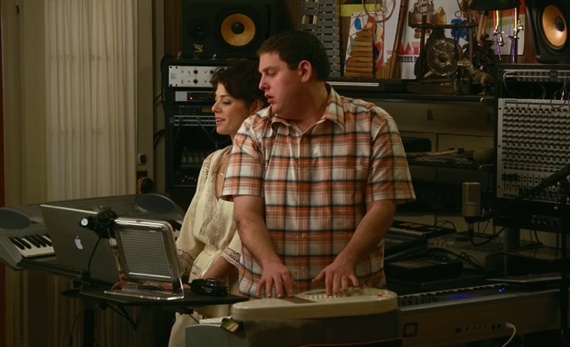
Makin' music - NOT Whoopee
As such, it’s actually quite an interesting – in theory only; the film is abominable, in case I haven’t made that clear yet – move for Reilly and Hill to have made. From the outside, I figured it for another Apatowian (it’s 3am, I am allowed to invent adjectives) fratpack movie, since both actors have made that sort their bag of late. But there aren’t any fart jokes, or sexual innuendos (beyond an intentionally woeful dinner table scene, and those are decidedly nuendos), because, well, there aren’t any jokes in Cyrus. But this is actually supposed to be a “mumblecore” movie, which rather makes sense, because despite all the talking there’s so little to the script here I have to wonder if one ever existed at all. It's hard to develop any kind of intelligent critique on a film that isn't merely without intelligence, but seemingly even without a brain, which might explain this flippant piece that I've garbled out in the middle of the night. But I could just as easily call Cyrus a Greek tragedy, and if I was as famous and respected as Peter Travers I’d probably land that quote on the poster, because Cyrus is, in its own excruciating way, a bit like a piece of true modern art: it can mean whatever you want it to mean.

Friday, January 14, 2011

"Did I just get saved?"

[If you’re unlucky enough to follow me on Twitter, you may have been irritated recently by my occasional quoting of Easy A, a film that I’d watched and enjoyed – mostly, as you may have heard from everyone who’s seen it, for Emma Stone’s star performance at the centre – a few months ago, but which has been on my mind lately because it was one of the set of ‘contemporary teen films’ I’d chosen to write an essay on. The following thoughts are an aspect that didn’t make the cut of my essay, but I thought them intriguing to note nonetheless. Spoilers for Easy A and Saved! follow.]

Easy A draws many inevitable comparisons to Mean Girls – teenage girl who wants to be popular spins some yarns to make herself the hit of the school, realises she’s become horrid person in the process – but one way in which they are practically identical is the parental figures within them. Easy A has more fun with Olive’s (Emma Stone) parents than Mean Girls did with Cady’s (Lindsay Lohan), but that’s probably due in large part to having landed actors with the wit and loose charm of Stanley Tucci and Patricia Clarkson - although that’s not to slight Neil Flynn and Ana Gasteyer, who certainly have their moments of fun rapport alongside Lohan (“What are my tribal vases doing under the sink?”). But the point here is that both sets of parents are supportive, understanding ones – and that’s the thing about the teen film in recent years. The parents aren’t the enemy anymore. No longer are they ignoring Molly Ringwald’s birthday or telling Winona Ryder to take the Volkswagen or just generally being repressive, old, MEAN old windbags who you’re better off only seeing at holiday gatherings.

"Spell it with your peas!"
But if the parents have turned into funny free spirits (“Spell it with your peas!”), we need to find a new enemy, or the poor teenage heroine (they’re usually girls these days) will have no one to beat down in moral victory. So while the enemy in Mean Girls is fairly self-evident – it’s, well, the mean girls – Easy A tackles a new villain: religion. Seemingly so characterised to ape the self-righteous Puritans of Hester Prynne’s world in the very self-consciously referenced The Scarlet Letter, Marianne (Amanda Bynes) and her conservative church group are the type who smile and pray for those they burn with hatred for.

Olive (Emma Stone), the besmirched
The film’s approach to this all doesn’t seem particularly well thought-out – Marianne thaws towards Olive, and then freezes again, all within about ten minutes of the film – and it rather half-heartedly throws in a sequence that is nevertheless useful to make clear what exactly might be going on here. Olive, overwhelmed with others’ ideas of her as a “slut” and a “whore” and her own knowledge that she made up the lies that provoked them, suddenly decides she needs religious guidance. She may end up pouring her heart out to a non-existent priest, and then happening upon a pastor who turns out to be Marianne’s father, but the fact is, spirituality exists as a valid concern for Olive, who might otherwise have seemed to be from a bohemian, agnostic family.

For a similar, if much more thorough, example of this, we can look back to 2004’s overlooked Saved!, with Jena Malone battling against her religious high school when she gets pregnant as a result of trying to ‘save’ her possibly-gay boyfriend. Interestingly, the main adversary here is, like Bynes, a former good-girl teen star, although Mandy Moore thankfully looks slightly less inflated than her contemporary. Moore’s Hilary Faye is a more foregrounded, and so much more vital, counterpoint to the struggling heroine than Marianne, and, while Easy A understandably casts Marianne aside, Hilary is central to the climax of Saved! and the nub of the point it rather bluntly makes.

Praise her. Praise Mandy.
 The reason for this intriguing new choice of conflict in films concerning today’s youth isn’t merely that social mores have progressed so that challenging these things is only now okay. Films have been there, done that, somewhere around the 1990s. Both Easy A and Saved!, in their rather awkward ways, push a mediation – religion is fine, and a belief in God is good, just as long as you aren’t so extreme about it. And there’s the word – extreme. It seems fair to argue that post-9/11, people weren’t sure where to tread. Roger Rosenblatt famously declared that it was “the end of the age of irony,” but no one was ever going to be so backward as to go back to a sheltered, conservative world where no one questioned anything. (Well, not in the film industry.) 9/11’s innate connection to extremist religion provoked two simultaneous, divergent reactions. One: against religion, taking this as another example of the kind of horrors organized religion can provoke. Two: against other religions, taking this as an example of what the “wrong” religion can do. Either way, religion was back at the forefront of discussion, and a viable source of everyday conflict.

The latter reaction would be the viewpoint of many of the characters in Saved!, and likely of Marianne too, but these films both seem to reflect the ultimate point of Rosenblatt’s declaration: “In short, people may at last be ready to say what they wholeheartedly believe. The kindness of people toward others in distress is real. There is nothing to see through in that.” Of course, we’re not dealing in death and terrorism here, but both Saved! and Easy A reflect that kind of proclamation of equality and generosity of spirit. Easy A’s Brandon (Dan Byrd) has an effective dramatic scene that showcases a kind of oppression that isn’t often depicted anymore (Nick’s gay bandmates in Nick and Norah’s Infinite Playlist have a more functional love life than he does), but it seems rather befitting given the Prop 8 struggle in California over the past few years – being gay still isn’t okay for everyone. Saved!, of course, lives in an even more repressive locale than this, where most things aren’t okay for anyone. But Brandon does a Huck Finn, and the gay teens of Saved! who’ve been sent away crash their prom to protest their right to be treated equally.

Look who crashed the weddi- I mean, prom
And in this inclusive spirit, of course, neither Marianne nor Hilary are beaten down by Olive or Mary (Malone). That’d just be mean. Instead, Marianne’s grievances are replaced with simple anger that Olive “slept with” her boyfriend Micah (a blank Cam Gigandet) (which, we can only assume, evaporates when she sees Olive’s webcast, though the film eschews any kind of “realisation” moment), and Hilary Faye is subject to a slightly pathetic end where she crashes into a giant statue of Jesus and asks her brother (Macaulay Culkin) if Jesus still loves her. Neither a happy ending, neither included in the heroine’s picturesque endings, but they’re not demeaned, and they seem to realise their mistakes.

The age of irony didn’t end, but the age where irony defined everything did. Our world has become so entrenched with cycles of cultural referencing that this type of teen film, a smarter subset than the more juvenile Hollywood blockbuster comedy, has to employ a certain amount of irony simply in order not to look naïve. But there’s nothing ironic about their romantic finales, nor about their sweet messages of equality. Perhaps you wish they didn’t have to tread so carefully, but there’s a certain amount of respect to be had for films that don’t so much want you to like them, but want you to like each other.

Sunday, November 07, 2010

LFF Review: Black Swan

USA

directed by Darren Aronofsky; written by Andres Heinz, Mark Heyman & John McLaughlin; starring Natalie Portman, Vincent Cassel, Mila Kunis, Barbara Hershey

screened as the Jameson Gala on September 22nd; also screened 24th and 25th

B-

The enduring effectiveness of Swan Lake suggests some intrinsic value in a story consisting of simplistic oppositions, even if it’s richer than it outwardly appears. The black and white colour scheme of the tale does not merely restrict itself to the decoration, of course, but inhabits the story itself: white is good and black is evil, and so on. By adding a splash of devilish red, Darren Aronofsky risks collapsing the delicately conflicting balance, but there has always been a more complex element to the fairy tale that is potentially much more damaging to fiddle with. The prince may fall prey to the vampish sexuality of the black swan, but the pure white swan he falls in love with in the first place is a damaged, sad, doomed woman rather than a purely innocent figure. By piling the complications of this story into one character, Nina (Natalie Portman), Black Swan risks cracking under the intensity of such psychological proximity. Though it theoretically, and increasingly formally, mimics the style of a ballet, Black Swan has to at least loosely tie itself to a sense of reality so we can make sense of it, and so the interiorized psychological approach it takes is somewhat inevitable.

Writers Mark Heyman, Andres Heinz and John McLaughlin are understandably wary of the complexity of mapping out the tale of Nina’s incoherent collapse as being inside her own damaged mind, but their lamentable approach is basically to divert in the opposite direction. Nina is less a protagonist than a victim, not someone who motivates the downward thrust of the script but is instead trapped in its clichéd ideas of familial oppression, realisation of sexuality and the mixture of physicality and psychology demands from her work. She is never defined apart from the darkness, from the moment she first glances at her reflection in the eerily depicted subway window, and is less of a character for it; only a headcase, not really a woman. This is not Portman’s fault, and you do see her working valiantly to deepen Nina’s narrative, to inflect a sense of independence into the part, but Aronofsky mostly directs her merely to react, not act, to gasp and widen her eyes and flinch and shout. There is fragility to Nina’s physicality that is all Portman’s, and without this the film might collapse completely, but there is so much possibility in the strained expression and nervous walk and their accoutrements that no one but Portman is interested in.

The necessarily telegraphed emotional style of ballet seems to recall Aronofsky’s own The Fountain, which channelled such primordial, florid emotions through its wild, impossible imagery. This makes it more difficult to comprehend why Black Swan fails at such a similar task. It isn’t the emulation of ballet’s narrative or formalistic aspects, because the delicious absurdities that Nina’s nightmarish imaginings (or are they?) reach follow through Aronofsky’s fantastically dark impulses to such effect that the film almost takes flight through style alone, rooted in a vague kind of connective tissue through the few successes Portman makes of understanding Nina. It seems, rather, that where The Fountain’s indulgent psychologies reached for a kind of transcendence, Black Swan seems content to nestle its mad flourishes in unilluminating, clichéd arcs. Vincent Cassel’s ballet master would make the same accusations of Black Swan as he does of Nina: it can’t let go, it can’t stop focusing on the technique of its performance. It can’t lose itself in an overwhelming, emotional story because someone hasn’t built one.

The script is too concerned with modulating between Nina’s mind and the reality of the world around her – something it makes a hash of anyway – and this becomes obvious in the ending, where Nina’s acceptance of her fate loosens the film’s grip and lets the blurred line between interiority and reality become unimportant, or even celebrated. There are scattered moments where it does this – Nina’s childish attitude towards sexuality bursting through as she bites Cassel’s character through a kiss, the manic horror of a visit to Winona Ryder’s hospitalized ballerina, and a key moment where Nina questions her psychology most vividly – but mostly it focuses on this divide to the detriment of any intriguing sense of character. Mila Kunis’ spry, sexy doppelganger walks this divide – necessarily defined through Nina’s psychology, she nonetheless comes to define a large part of Nina (through what Nina isn’t, and what she becomes) because Nina’s own characteristics are so thin and undefined. Ultimately, Black Swan is less the story of a ballerina’s descent into madness than the portrait of a woman who happens to be mad – the barest shadow of Nina exists before her freefall, and Portman can’t even pretend to invent one because the production affords nothing beyond giant stuffed animals and music boxes in her bedroom.

When a film like Black Swan comes along, a whole congregation of people breathless in anticipation over it, any disappointments you find with it are hard to ignore. In fact, despite the catalogue of narrative problems, the aesthetic and thematic elements of Black Swan pack quite a ferocious punch, even if they’re often too slavishly exacerbating the film’s problems. There was never any doubt that Aronofsky had set himself a difficult task trying to get his style and this story to actually spark into the remarkable kind of experience they seem designed to make, but for every decadent flourish that burns onto the eyeballs there’s a tired cliché rolling out of someone’s mouth, and Aronofsky clings just a little too tightly to a normalizing narrative that immersion in the style proves an elusive quality. Lose yourself, Darren. You’ve done it before.

Monday, October 25, 2010

LFF Review: Patagonia

UK

directed by Marc Evans; written by Laurence Coriat and Marc Evans; starring Matthew Rhys, Nia Roberts, Marta Lubos, Nahuel Perez Biscayart, Matthew Gravelle, Duffy

screened on September 21st, 22nd and 23rd

C-
A truck rolls by, a faded name on its side. ‘Patagonia’. Perhaps once a tourist spot, but the guide driving his rusting truck only has these two visitors to look after, so it seems business is as faded as the emblazoned word and the dusty desert plains they wander around. This could, quite easily, simply be Argentina, though perhaps that lack of distinction is the implication in the barely-there advertisement. But it’s unlikely, no, that a film would name itself after something so intriguing and then barely engage with it? For the soap-opera dynamics of the half of Patagonia that actually takes place in Patagonia don’t have any need to be there at all, although I doubt they’d be much more engaging in California or Siberia than they are here. Rhys’ (Matthew Gravelle) actual interest in the architecture of the churches he’s been assigned to photograph is part and parcel of why his girlfriend Gwen (Nia Roberts) engages far too deeply in her flirtation with their guide (Matthew Rhys, not very rugged at all). Gwen is never at home here, and, despite the mistakes she makes, the film never suggests a disagreement with this. Wales is, as for Gwen, where Cerys (Marta Lubos) feels she should be as her life nears its end – so Patagonia, then, is for all not somewhere they are truly happy.

Rather curiously sheathed in half, with two plots that are cleanly unrelated, the film swerves between Patagonia and Wales without much rhyme or reason. The more dominant – and naturally, less interesting – half is drawn rather tiredly in Babel-like colours, from the dusty golden glow of the cinematography to the august plucking of the score, and there isn’t much sense of Patagonia as a place distinct from any of the rest of South America, except that the characters – two of whom are visitors – speak in Welsh. Showing the disconnect that should likely be the point of the film, the characters in Wales speak in Spanish, though this plot is played much more heavily for the cultural tension. Though she provides the inevitably poignant climax, Cerys is mostly an excuse for the coming-of-age arc given to Alejandro (Nahuel Perez Biscayart), though his encounters with European tourists, loutish locals and a sweet Welsh student (Duffy) are hardly the most narratively sharp of experiences.

The film seems to be commenting on Patagonia’s status as more a beautiful artefact than a country in the way it interpolates the flashes and exposures of Rhys’ camera, and its emulation of his painterly shots. But as the soap-opera dynamics crowd the film and Wales is inevitably depicted as a rosy, pastoral landscape, any deeper angles that have been vaguely suggested are shunted aside. By reducing its characters to such familiar arcs, the film can’t give them any more than a superficial depth, and generally isn’t interested in engaging them with the histories of the foreign worlds they engage with. The brief hints of something more specific that we are given make the film’s overall disinterest even more maddening – there are stories here being ignored, snubbed for ones that have probably been written during a deep sleep. Often a failure is more catastrophic when the target aimed at was never high enough in the first place.

Thursday, October 21, 2010

LFF Review: Les amours imaginaires

Canada

written and directed by Xavier Dolan; starring Xavier Dolan, Monia Chokri, Niels Schneider

screened on October 21st, 22nd and 24th

B

I confess. I have a weakness for young, attractive French people giving themselves over entirely to their lustful urges. Xavier Dolan himself is a young and attractive Canadian person, but he’s from Quebec, and I do believe that’s included in Subsection 1B of my confession. After his vaunted J’ai tue ma mere, Dolan again directs himself in Les amours imaginaires (feel free to explain the disastrous English title, Heartbeats), though he can of course hardly cast himself as the object of everyone’s affection. The dark energy of his filmmaking refracts the few moments of possible sexualisation of Dolan himself as instead slightly self-critical, an awkward physicality we don’t see in Marie (Monia Chokri), or the friend both she and Dolan’s Francis fall for, Nicolas (Niels Schneider).

Dolan achieves these moments through techniques he’s rather boldly cribbed from Wong Kar-wai – it may not be accompanied by In the Mood for Love’s striking musical theme, but you can almost see a pot of noodles swinging from Marie’s hand. Yet there’s something strangely effective about these almost exhausting stylisations, particularly a slow-motion entrance to a party matched to House of Pain’s ‘Jump Around’, that undercuts the imagery so hugely that it almost brought me to tears. Unlike Tom Ford’s imitations in A Single Man, Dolan doesn’t merely copy but adapts these techniques, acknowledging his influences but using an undeniably powerful technique in a different way. These moments in Heartbeats aren’t melancholy, and in their proliferation they shift away from being ellipses – they seem at once ironic and directly devastating, emphasising the sexual dimensions so exaggeratedly that it falls somewhere between mocking and pitying the characters they depict. At no point is this attitude clearer than a purposefully prolonged, simply shot scene where Francis, left alone in Nicolas’ house, furiously masturbates over some discarded clothing.

On the other side of this coin, while Francis and Marie are ironically sexualised and depicted as desperate, Nicolas is removed from most senses of the ‘real’. Inevitably slightly human through the mere existence of the dilemma as to just how much aware he is of his friends’ infatuation, he is nonetheless constructed more as an object, a pretty face and a mop of hair. The epileptic lights of a party emphasize his separation from his admirers: while they are grounded in the space, a continuously moving, unbroken image, he exists only in between the flashes of the lights, his movements frozen images. To Francis and Marie, and ultimately to us, he is simply the physical. Dolan’s script affords him only basic characteristics – and hints that these are mostly unattractive ones – and, though a thankless task for the actor, it needs no more than this from him.

When you finally realise how incidentally the collapse of Francis and Marie’s friendship is treated, the film’s odd rhythms begin to make sense. Interspersed sex scenes show Francis or Marie with unnamed partners soaked in one particular colour of light, a kind of sexuality that is so baldly expressionistic that it is more image than reality, a more mystical eroticism. Dolan consumes you in sensuality and focuses you on the mistrustful dynamics of love, so that while you might not match the lust for Nicolas, you lust for this mood in general; you are reduced to the carnal, the basic desire. It isn’t about liking these characters – the sneering ending makes that clear – but about identifying with how low these familiar feelings have made them, and can, have, and will make you.

Monday, October 18, 2010

LFF Review: Meek's Cutoff

USA

directed by Kelly Reichardt; written by Jonathan Raymond; starring Michelle Williams, Will Patton, Bruce Greenwood, Rod Rondeaux, Paul Dano, Zoe Kazan, Shirley Henderson, Neal Huff, Tommy Nelson

screened on October 18th and 19th

A-

Early in Meek’s Cutoff, we watch a carriage rattle out of frame, and see a man on horseback appear on the hill behind it. Except we don’t, because that man is on a different hill, ahead of the carriage, and this is two shots gradually dissolving between each other. For brief moments, the landscapes merge. They are, of course, the same landscape, the same rising terrain that the travellers we follow have to contend with. Seemingly an echo of this comes later: “About the same as the rest of us, I’d say,” Emily Tetherowe (Michelle Williams) utters, about the native man (Ron Rondeaux) the troupe have captured. Meek’s Cutoff isn’t exclusively about Emily, but her fiercely-thought views sparking against those of others in the camp are an integral motivation within the story. This is the mid-1800s, and not only is someone insisting that this unknown native is their equal, but a woman is doing so.

In the hands of the subdued yet purposeful style of Kelly Reichardt (the mysterious Old Joy, the melancholy Wendy and Lucy), Meek’s Cutoff is never in danger of overemphasising these social dynamics, instead playing them out with careful framing and a gradual increase in tension, cleverly achieved through the diversity of acting styles rubbing against each other. Williams as ever plays things with inward subtlety, while Paul Dano ropes Zoe Kazan into his wide-eyed hysterical dramatics and Shirley Henderson frets quietly on the edges. As the film progresses and the situation becomes ever more fractious, Reichardt directs her actors to reveal the delicate imbalances within the group, each character slowly becoming trapped in their own combustible eccentricities.

Meek’s Cutoff feels like the natural evolution of Reichardt’s attitude towards her filmmaking – it is broader than but not indistinct from her previous films, an experiment in how starkly different elements (of plot, of acting, of character) can be understood in the low-key shooting style many admire her for. Instead of simply aligning with the type of character that typifies her film, Reichardt’s approach extends the ambiguity to every character, never answering any questions we have about them and which they have about each other, and even ending at a completely unexpected, yet reflectively perfect, moment.

As she extends her canvas, her style adapts – framing things in such a way that while the sound focalises attention on one area, our eyes are, perhaps, supposed to drift to another occurrence. She rests shots and carefully manoeuvres the characters to form a sense of being inescapably in someone else’s presence, even in this vast wilderness – the travellers need each other, but simultaneously the antagonism grows. The discordant cello notes of the soundtrack accentuate all these tensions – suggesting menace, or melancholy, or merely despair, or perhaps all of these and yet more. Beyond steady, naturally evolving arcs, not least Emily’s growth into a woman who’ll tote a gun at a man, Reichardt’s project is to suggest and not explain, to craft a small world of these travellers, as fascinated and traumatised by the landscapes as the viewer becomes. Meek’s Cutoff is less a Western than a film set in the locale of a Western; it digs into the typicalities of the genre, but its digging seems natural, to unfold from the dilemmas of the characters. The cutoff of the title, if it alludes to anything beyond the obvious, is the disconnect between the characters, separating even as what happens to them necessitates tightening their pack.

Friday, October 15, 2010

LFF Review: Never Let Me Go

UK/USA

directed by Mark Romanek; written by Alex Garland; starring Carey Mulligan, Andrew Garfield, Keira Knightley, Charlotte Rampling

screened as the Opening Night Gala on October 13th; also screened on October 15th and 17th

C+

Never Let Me Go. The words float from the cassette recording, an unknowing request through a romantic gift. That the cassette has shifted from being a melancholy emblem in Kazuo Ishiguro’s novel to something fleetingly included here seems at odds with the change of project the film seems to pursue. But this short shrift isn’t exactly representative of a film that could be simply described as diluting its source. It seems instead to refocus it, keeping Kathy H’s voiceover merely as a bare framework as opposed to its overwhelming first person presence in the novel, and explaining the secret of these characters’ existence almost immediately, to channel the involvement into the love triangle instead. Perhaps a slight trivialisation of an intriguing topic, but Ishiguro’s novel hardly delved deeply into the wider repercussions of this alternate past either, blocked by the particulars of Kathy H’s ‘human’ experience.

So maybe Alex Garland’s script makes for a more honest approach to Ishiguro’s obtuse disguise by shifting focus, but new weaknesses crack through; Ruth (Keira Knightley), always the least explored and probably least interesting point of the triangle, is almost demonized, hovering menacingly behind doorframes and giving cruel looks to Kathy (Carey Mulligan), a girl who is supposed – and the paucity of conviction in this is the film’s weakest aspect of all – to be her best friend. None of the characters are helped by the child actors who play out the difficult dynamics in the first section – not exactly aided by a script that seems too keen to truncate the school experience (seen most baldly in the terribly expositional role Sally Hawkins is given), but too studied and brash to work against the harsh angles of these early scenes. Ironically, it ends up being Knightley’s late scenes as Ruth that are the most striking, with a heavy weight to her words and physicality that seem entirely unfamiliar from the lithe actress, but by then Ruth has been and has herself let go.

Yet somehow, despite the strength of Knightley, Carey Mulligan and Andrew Garfield, the stronger leaning towards character over moral dilemma does not change the approach the story takes in trying to move us. Without really exploring how these ‘clones’ function in this universe – two frissons with strangers they watch during a trip to a seaside town hint at this wider idea – we can only accept them as closed off from the world, and so Garland’s favouring of characters makes sense. But at these same moments, the imagery (a ball, lost over a fence; a panorama of the broken toys the students joyfully ‘buy’) and the ending try to open the film up to the moral dilemmas. It’s something the film can’t let go of, because it singularises it, but it can’t find a way to properly modulate between the two different angles.

It has to, by design, mark out our focus within the segregation – so while they’re all “students of Hailsham”, Tommy wears blue to the white of the others, or Kathy sits outside, disinterested in the excitement of the sale. Naturally, while our characters might be clones, they’re less clones than those around them, and this niggles as an excuse to merely scratch the idea of this society and not investigate it. If I keep repeating this point, it’s only because it seems to be an impossible situation – perhaps it’s the necessary truncation into a manageable length that was never going to be able to finely contain the details of the novel, no matter how much the cinematic treatment might help the story by packing pages of Kathy’s observation into single images. The specificity both gains and loses something. Like the clones, perhaps, the film isn’t inferior; it’s just troublesome in a rather different way.

Monday, August 09, 2010

The Evolution of Susannah York

Over three years ago, I wrote a piece about one of the most singularly striking cinematic moments I'd ever experienced - Jodhi May's startling look to camera in The Last of the Mohicans. I've not revisited the film since, and naturally the moment isn't as sharp in my memory as it was then, but the feeling it invoked - akin to being electrified - is still an unforgettable one. If you're reading this, you're probably a cinephile, and you've probably had a few of those moments yourself - they're rare, and of course all the more special for that; their singularity, their shock factor if you will.

What this is obviously leading up to is the arrival of another one of these moments in my film-viewing life. The contrast was perhaps less stark than it was with Jodhi May - They Shoot Horses, Don't They? had already stirred up a mixture of despair and horror in me - but it perhaps says more about the craft on show here that it still felt like I'd stuck my fingers into a plug hole. Unsurprisingly, there are major spoilers ahead.

Alice (Susannah York) is introduced as an immaculate contrast to all the worn down, dowdy women who are queuing up for the marathon dance contest with her; her on-the-spot rendition of Shakespeare exudes an air of superiority in her Britishness, her clean dress, her sparkling coiffure. Like all those who surround her, though, Alice is pummelled by the physical demands of the contest, and her decline is all the more dramatic for the heights at which she begins. After Sailor (Red Buttons), a victim of a second ten-minute sprint around the dancehall, collapses stiffly onto her dress, Alice cracks. Tainted, she thinks, by death, she flees to cleanse herself.

There is something about me, evidently, that has a mind that responds so much more heavily to physical acting - Susannah York barely utters a word in this scene, yet it was, for me, the most arresting, stunning scene of a film that is hardly short on the despair (it is, of course, heavily rivalled by the climax, but that's a discussion for another time). Like Jodhi May, here an immensely dramatic confusion can only make itself known through physical expression. The collection of York's faces I've catalogued here might seem a bit pantomime - it's hard for me to judge, so fresh from experiencing it in motion - but if York's performance is the most overt in the film, the character does not suffer for it.

This isn't just Alice's breakdown - it acts as the film's, the awaited implosion of physical and mental torture that all the characters are enduring. Alice, with the most fragile personality of them all, is the obvious choice for this all to collapse onto. We've seen her freak as she manically pushes Sailor's body off here, but here the full schizophrenia of her breakdown makes itself apparent as she gives the showerhead a deranged smile - a clever opening to the scene, handily reflecting her mind's distortion in a single image before letting York's face do the legwork.

She doesn't know where to scrub herself - her hands concentrate on her midriff, where her dress still remains, but she paws wildly at her arms, her legs, her back, as if she's lost all sense of her body. Because, of course, it's her mind that has been tainted, not her body. She glares at her fellow competitors, who are standing back in bewilderment, disgust and alienation, but jerks in fear at the matron's appearance, giving a triumphant, manic smile when she fends her off.

The contest's compere, Rocky (Gig Young), is a different matter. There's no glare here, more an inquisitive, wary stare; a summation of Rocky's presence as a character, then, as throughout the film he is caring towards the competitors, yet always views them as competitors, as attractions, as numbers. Alice's smile here might signify the boost she gets from male attention; or simply relief that he has sent the others away, that for a second she believes he can actually help her, free her from death's taint. But he tries to get near. The smile flips back to fear.

He moves to turn off the water. She's not clean. She can't possibly let him; the eyes widen. But his gentle, careful voice cuts through her madness a little - disappointment in herself dawns and she moves away. The movements on York's face are sudden and sharp, yet there's a perfect, simple logic to them: she's not clean and she needs to be. "He... touched me," she says, bewildered - death is active, something to be feared. "Is he dead?" If he's not, she can relent, she can survive.

Rocky assures her - falsely, we sense (Sailor looked pretty dead) - that he's going to be fine. Relief - perhaps - rushes through her and he can move, slowly, towards her, through the falling wall of water, the divide broken. But then the alarm shrieks, it's time to go back to dancing, and she screams.

"Someone screamed." "That was you, Alice."

With that last line reading, Susannah York sounds as though she's stepped out of a ghost picture - and, with the shells that the characters have become, she has done. The title - uttered glibly at the film's tragic end - suggests that the Depression has made people into lame, vague approximations of humans, ones that, if they were horses, would be shot, because they're no use to anyone any more. Gloria (Jane Fonda) chooses death, though she is even too lame to do it to herself. Robert (Michael Sarrazin) chooses imprisonment, where he will likely waste away. And Alice escapes into madness. It's a stark message from a stark film that says as much about the Great Depression as it does about the darkening mood of the late 1960s that was the overwhelming mood of 1970s American cinema. But starkness sometimes makes for the very best, the most human, of cinema. A

Friday, August 06, 2010

Ode to Smiley Face

That is where laughs come from. Hmm... maybe ol' Gregg Araki is onto something. He probably really loves pot. And all pot-related confections! I mean, isn't that what you're supposed to put in a frame? Things you love? I'm gonna do that. When I get home, I'm gonna frame a bunch of stuff I love. Like Anna Faris. I love Anna Faris. She's SO good. And funny. You know what else Anna Faris was in? Scary Movie. Man, she really was in a lot of those movies. Maybe I should put a picture of Ghostface in a frame. You know, as a kind of shorthand way of saying 'I love Anna Faris'. That would be so fucking inside. Or how 'bout a photo of Billy Loomis from Scream? Oh shit, that would be totally meta! People would be all like: "David, why do you have a photo of Skeet Ulrich on your mantle"? And I'd be like: "because I like Anna Faris, of course".

(B+)

Monday, March 08, 2010

Wonder-par

Alice in Wonderland is somewhat of a misnomer. Oh, Alice is here, alright, although older and possibly a bit wiser than you’d expect; she’s not in Wonderland, though. Apparently she misheard - it’s “Underland”. A joke that suits Tim Burton’s gothic sensibility, maybe, but it also reveals that Lewis Carroll’s classic children’s book and the director aren’t really the perfect fit they initially might seem. Fact is, Burton’s a far cry from his Edward Scissorhands days - for my money, far and away the finest film he’s ever made - and critical favour towards his watered-down black magic has been waning, even as box office figures balloon in the opposite direction. Underland is less delightfully insane than Wonderland ever was, and the fantastic dress-up Johnny Depp and Helena Bonham Carter do is more pantomime than anything else. Tim Burton doesn’t celebrate and cherish the odd anymore; he was thrust into the mainstream and the only thing they do with weirdness there is laugh at it.

You only need remind yourself of the tiresome addition of a humanizing father flashback for Willy Wonka in Burton’s adaptation of Charlie and the Chocolate Factory to see that Burton is afraid to let weirdness stand tall and proud these days, and it’s much the same here. Lunatic supreme the Mad Hatter (Johnny Depp, but of course) isn’t the incomprehensible oddball of the novel but someone haunted by the past, and while Depp carries this damaged persona off surprisingly well it can’t help but jar, not least because it thrusts him so far into the forefront of the story they might as well add him to the title. I’ve yet to hear any good reasoning behind Burton’s invention of this whole additional story - the original story’s immense charm and appeal was in its freewheeling, loose nature, and that’s something you feel Burton of old could have carried off. This new story arc is yawningly traditional, and the darkness of feeling the added years (Alice has returned to Underland now a young adult) drags the charm down into the mud.

I’ll take the good points where I can get them, though. While a story focused on Alice would have been preferable - that is, one that doesn’t cut away from her entirely as this does - Mia Wasikowska isn’t really a strong-enough screen presence to maintain that sort of thing. She’s pleasant, but slightly innocuous. So despite the mangling of source material, one queen becoming two provides more queen for your dollar, and both Helena Bonham Carter and Anne Hathaway deliver. It may be becoming a bit boring to see Bonham Carter in every film her partner makes, but she was always the perfect fit for this role - a screaming, impulsive, big-headed (literally) tyrant. Better, though, is Hathaway, whose White Queen floats around airily and angelically whispers her commands, but Hathaway strikes the ironic notes of someone who’s clearly not that perfect, who may be better than her sister but knows it, relishes it, enjoys their childish animosity.

In the end, it’s all about expectations. I long gave up expecting Tim Burton to impress me. Maybe sticking to the original story would’ve brought out the spark in him again, but he didn’t do that and instead he just poured drab darkness over it. His regular collaborators feel a bit freer here than they have done previously, but one senses Burton and co have fallen into a routine they could walk in their sleep. And Alice in Wonderland might be a dream (or is it?), but it’s a fantastical one, a bizarre one; not one with such inevitability to its tread. It feels less like something Burton would want to make than something concocted in a clinical studio boardroom, and he was just the weird director for hire. C-

P.S. I hope to be around a bit more from now on. This was my first 2010 film, so think of this a New Year's Resolution.

Sunday, January 17, 2010

Supporting Actress Blog-A-Thon, Class of 2009: Leslie Mann in 17 Again and Funny People

I'm going to be honest with you right from the start: I don't like either of the films that are listed in the title. 17 Again is a rotten example of the complete lack of invention in both comedies and teen films Hollywood shows these days, and, while I'll give Funny People credit for making an effort, it just didn't come off very well. The actress I'm going to talk about is a bit trapped in the system, really, what with being married to the director of many of the wave of 'bromance' comedies that dominated the second half of the 2000s, but, nepotism or not, Leslie Mann has slowly been becoming more and more of a shining light in Hollywood. And she was the silver lining in these two films.

Scarlett O'Donnell in 17 Again and Laura in Funny People

As almost the only adult female of any depth in either film - as already noted, Judd Apatow films are dominated by men - Miss Mann (no jokes please) is saddled with more dramatic arcs than any comedic moments, although this is by no means supposed to suggest that she isn't funny. Her understably confused attraction to Mike (Zac Efron), her ex-husband back in younger form (although of course she doesn't know that), takes on a more dramatic bent but the first moments of it are pure comedy, and well played by Mann. It's very cartoonish - Efron's face is surprisingly doughy - but as ever with Mann, there's more to this. She's transfixed by him, as if some part of her brain registers that this IS her ex-husband, though of course common sense can't let her admit that. Her line readings are slowed, as if her brain is too busy trying to figure out what's going on to let her speak properly. "You wait here, I'm gonna go smell him," she says to her friend, her matter-of-fact pointing emphasizing how she currently finds that a completely normal thing to do. Scarlett is the audience surrogate - the stable character who has to make sense of being thrown the same person in two different forms. She is the heart of a movie that's rotten on the outside with idiotic comedy and lame slapstick, but there's her light flickering at the centre.

In Funny People, she's again positioned as one of the film's more dramatic parts, and, while her most notable 'comic' moment (aping Eric Bana's Australian accent) doesn't work at all, it's another of her scenes that's stuck in my head. George (Adam Sandler), her childhood sweetheart, has come back into her life and confessed his love for her - and Laura's reaction is heartbreaking. It's a moment that feels genuinely sad after all of George's rather pitiful gloom and askings of people to kill him. She doesn't lie, like you might expect her to; she freely, tearfully admits that yes, she still loves him, and yes, he fucked it up and now she's married and she can't do anything about it. (And she doesn't care, ultimately.) Her antagonistic - but complicated - relationship with her husband (Bana) is the most deeply felt and real aspect to an otherwise bloated movie, and, previously mentioned accent-shenanigans aside, the pair work in tandem to provide both believable family drama and comic lightness.

Leslie Mann is the star of neither 17 Again or Funny People, but she makes herself the star, and not through any selfish scene-hogging. She's a generous actress, a real member of any ensemble she finds herself in, yet by her very nature she marks herself out, by her warmth, her comedic skills, and her empathy. She received notice back in 2007 for Knocked Up, but she knocked her game up even more notches in 2009 and I hope she is given more chances to impress - maybe even gets a vehicle of her own.

Saturday, December 05, 2009

Beware the ideas of Orson.

Written in the style, or at the least in the attitude, of Orson Welles.

YOU THERE! Yes, you! Don't think I can't see you, I've got eyes in the back of my head. Come and sit down. Be quiet! What I've got to say to you is much more important than whatever you've got to do. It always will be. How can I respect you if you're not fully committed to this thing? Good. That's better. Now pay attention. I'm only going to say this once.

You must see Me and Orson Welles. No, no, it's no masterpiece - I can easily admit when things aren't perfect, you know, for often it's the imperfections that make things so palatable to the human emotions. It was always going to be the way with Richard Linklater, anyway - the man's style is too loose, too free to ever let a tightly contained masterpiece out of his soul, and here that's even tempered by the rather obvious structuring of the piece. You can't blame him for that, though. He had to work with the sub-par writing he was given - the man's a director, a visionary, and it's a shame he has such amateurs around him. I'd never let such things pass, naturally.

It feels a little under-budgeted, a little too enclosed to really engage on a sensory level, but we've all had to work with money constraints, haven't we. It all works with the theme of creating a masterwork out of rag-tag bits and disasters. At least it looks good - that Dick Pope's been around for a while, always making things look stripped-back in an attractive sort of way (the best way to be, really, don't you agree?), and he never gets enough credit. Give those costumers, credit, too, especially for undermining Zac Efron's naive cockiness by putting him in dungarees (good lord) and shirts that are miles too big for him. Nice details, but they don't go unnoticed by my keen eye. Nothing ever does. (Stop fidgeting.)

Then there's that Zac Efron. Too pretty for his own good, that boy is. He usurps the whole thing, almost, just by existing. I'm not denying I'd like a thing with him on the side, really, although no one of us has got into his pants yet so I wouldn't bother trying. (Plus if you do I'll make sure you never work in this town again. SIT DOWN.) He's good, though; he cleverly uses the arrogance it's easy to see in him to deepen the character's youthful, misguided arrogance. And really, Christian McKay is so strong, so unmatched in magnificence that even Zac's face can't run away with the picture. And I've not even mentioned that Claire Danes commits her easiest, most engaging performance in several years to her part, or that the ensemble cast makes the film feel even more alive. I see a lot of myself in McKay, actually - the fearlessness, the passion, the raw magnetism. He even manages to make the obligatory "see, this guy isn't a monster really!" moments work by carving them from the exact same piece as the rest of his performance, and muddies whether this moment is really you seeing Welles' soul or merely another manipulation. Without him, the film would be severely lacking; it'd simply be called Me, and that's a ridiculous title. Who's so self-obsessed they'd see a film called Me?

WHAT DO YOU MEAN "I WOULD"? You're fired. Never show your face around here again. I don't have time for amateurs like you.

(B-)

Thursday, October 22, 2009

Chloe, (A Lady) in the Night

Cold. Julianne Moore is cold. Not just in the physical sense - I mean, it is pretty chilly in Toronto, but she's also cold in the more figurative sense. She's cold like the smooth white surfaces of her doctor's office, like the spotless glass walls of her house, like the frosty, uncommunicative marriage she's in. A-ha! The crux of the matter. Catherine doesn't trust her husband David (Liam Neeson), what with him being the tall, handsome, smooth-talking lecturer he is, so she hires a glamourous prostitute she's noticed to test his fidelity for good. But Chloe (Amanda Seyfried) gives Catherine more than she'd planned to pay for.

A vague plot synopsis, like the one found in the film festival's literature, makes Chloe's icy erotica seem coyly alluring. A full plot synopsis might reveal the more tawdry aspects of the film, but what delight there is within Atom Egoyan's latest may well remain within the unfolding, so I'll keep as mum as I can manage. But something doesn't feel right from the start. You can film a cold place but it takes something more to make the film cold itself - and Chloe is too heavily photographed, too close to really appropriate that at all. There's no law that says a film set in Canadian winter has to send chills down the back of your spine, but what Chloe's atmosphere is instead is just a bit vulgar and melodramatic. The music is all swelling piano dramatics, the generic atmosphere a stilted, canned laughter type of place... it's a good thing we've got some nudity to spice things up, really.

No, but Moore and Seyfried aren't bad, exactly - a shame in a way, since this has the elements to make it a fantastically bad picture, but it settles for being merely 'not very good' - and the way events play out between them is certainly the most intriguing and interesting aspect of the film. Moore has never been afraid of exploring aspects of a woman's sexuality - despite continually swearing she'll never do it again, she insisted at the press conference - and here she nicely plays the arc of a woman fighting growing older and rediscovering the sensuality that had been buried beneath routine and disconnection. Seyfried is the bigger revelation, though, with a performance that, before the film takes a strong turn for the brainless, is intriguingly coy about who this woman is and what she wants, and more than anything proves that this is a young woman with incredible charisma. The film is, in as much as its psychological aspects end up making any sense at all, about figurative visibility - Catherine feels like she's faded with age, her husband 'doesn't see her'. More interesting is Chloe - does her profession give people licence to view her as a sexual object, or a purchase?

It's a great shame that Chloe, while certainly no masterpiece before it slides into tawdry thriller territory (an aspect not present in the French film, Nathalie..., on which the film is based, and apparently something we can blame producer Ivan Reitman for), throws these promises of psychological insight down the drain. Perhaps it was inevitable - it is, potentially, Chloe's 'performance' that keeps us intrigued, wandering as she does between frankly sexual and coyly childlike, and the stripping back of all this leads to some ludicrous overdrama. Atom Egoyan can wax for as long as he wants about how this is an adult, complex psychological drama about 'human interaction' and 'mature relationships', but the truth will out - it's an erotic thriller with remnants of French intrigue that can't help overloading on inexplicable obsessive madness, blowing all subtle humanity to the wind. Or out the window. C-