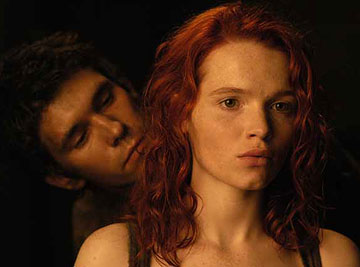
When I first saw Atonement, all the way back in September (Britain got it a few months earlier than America and most other countries), I was fresh off having read (and loved) the book- as usual with books that aren't prescribed parts of my course these days, it was only because they were making a film out of it that I read it. Naturally, the issue with watching a film of a book you've read is that you're naturally going to make comparisons- but reading the book so close to watching the film is possibly unadvisable, because it makes you even more prone to paper over the film's omissions (which are often necessary or effective ones) with pages that are still living vivid life in your memory. Characters seem more than they are because the versions the book and film offer up to you are different things- not a problem, perhaps, when watching at a studied distance, but the character of Cecilia, say, who was granted a greater deal of interiority than the film affords her, seemed less rounded and human on a second, more removed viewing than she did initially, because in my head first go round was still the Cecilia from the book.
Trying to make a truly faithful version of a book is always a mistake, really, because, as with plays, the whole thing generally comes off as too stilted, too formal and constrained, because you get the sense that the filmmakers are ignoring any possible artistry in an attempt to portray exactly what the book gives you. Atonement does not have this problem, because Joe Wright, its director, does not let it. This isn't to say, though, that it's not seeking to be faithful to the book in a disadvantageous way- it just goes an entirely different route towards achieving it. We learnt from Pride and Prejudice's famous circuitous long-take around the rural family home that Wright is a director often prone to flashiness- but here, with Atonement, he seems too often to go slightly overboard. He may not be keen to tell us the story, so to speak, but he is intent on showing it to us, and all too often his visual attempts to do so seem overbearing and unsubtle. Grone-inducing visual metaphors like Cecilia (Keira Knightley) diving into the swimming pool cutting sharply to Robbie (James McAvoy) sliding up from under his bath water, or the insistent close-ups of that infamous word that wasn't meant to be seen being typed across our screen, sit uncomfortably alongside the classical style Wright favours for most of the film- most egregious, possibly, is his reversing flashback of Robbie and Cecilia's separation, to not mention his infamous five and a half minute tracking shot around Dunkirk, which seems to serve no other purpose that proving it can be done. Dario Marianelli's score is for the most part delicate and effectively melancholic, but the typewriter sounds that spark up on young Briony's (Saoirse Ronan) appearances- which undoubtably are what won him the Oscar- are jarring and altogether too poundingly insistent. And Christopher Hampton's script is too often as unsubtle as Wright himself- particularly, it has to be said, in the coda, for which I previously placed too much blame on Vanessa Redgrave, but it's really the fault of having what was in the book revealed by a first person narration but is here forced to be revealed in one long, overt speech.
Atonement's productional credentials are generally faultless- impeccably-created sets, good costume work, ecetera- but ultimately the whole thing does feel a bit empty because there is barely an actual character to identify with. Robbie and Cecilia, even moreso than they were in the novel, are less humans than idealized romantic fiction, and, while that is the point that McEwan ultimately makes, he also invested time and energy into the pairing, using their perspectives to eschew the possibility of making them into ciphers for Briony's atonement. It's harder to pull off different perspectives on film without being overly explicit, and, even while spending most time with Briony, Wright refrains from actually entering any of the characters heads, and this means that the film loses any chance to understand either Robbie or Cecilia, leaving both McAvoy and Knightley asea amid clipped British accents and creaseless formal clothing. Obviously Briony is more of a rounded character, but here it's more a case of the actors letting the side down- Romola Garai is easily the best here, redemptive and haunted as her eighteen year-old Briony struggles with nurse training and contacting her estranged sister, but Saoirse Ronan, much-praised as the younger incarnation of Briony, works too hard to try pull off the adult-acting aspect of her character, which, in one of the novel's clearest ironies, is all a fallacy anyway. Ronan is good at portraying Briony's slightly lofty attitudes, but she's a tad too vacant, lacking any edge in her clearly-meant-to-be-meaningful stares out of the window, and not nearly as good at underlining the empathic moments of Briony as Garai is. And Redgrave, stuck as she is with that expositionary coda, works like a trooper to inject some emotion into her face as Wright holds steady on her close-up, but, not only is she undermined by an understandable but still foolish choice to have her basically look like an overgrown Ronan (same hair cut, swamping dress), there's just little she can do to make the words seem less deadeningly unrealistic than they are.
Atonement works, maybe, as the sweeping period romance that you feel the Academy probably took it for, but as the more subtle depiction of the devastating effect of falsehoods and misunderstandings the book proves itself to be, the film fails. There's no real sense of tragedy in Robbie and Cecilia's separation because they're never relatable, sympathetic characters. Indeed, the film's best moments belong entirely to Garai, as she depicts the tragedy she unknowingly did to herself- rather lamely sitting by a French soldier's bedside, unsure whether to go along with his delirious 'remembrances' of her; but especially in the film's coup-d'etat, Briony's confrontation with Robbie and Cecilia. Nathaniel highlighted this line reading in his recent awards, but it bears repeating for just how perfectly Garai captures Briony's wretched regret, her pathetic apology coming out as if she knows how redundant it will seem. It's a superb performance in a film that doesn't seem to want one, more concerned with the tragic romance and directorial flashiness than telling the story that McEwan told. C+